HIFU vs RF Skin Tightening FAQ: Expert Answers for Aesthetic Clinics & Dermatologists
Overview
For B2B aesthetic clinics and dermatologists, selecting between High-Intensity Focused Ultrasound (HIFU) and Radiofrequency (RF) skin tightening devices is a critical capital investment decision. This FAQ provides expert answers on clinical efficacy, safety across skin types, ROI, and technical support to guide your purchase.

Frequently Asked Questions
Q1: Which technology provides better lifting and tightening results: HIFU or RF?
HIFU generally provides superior lifting effects for the mid and lower face due to its deeper tissue penetration. A clinical trial showed the ultrasound group had superior efficacy over the RF group in the mid-face (p = 0.004) and lower face (p = 0.046) at the 1-month follow-up . While both modalities are effective for collagen regeneration, HIFU targets the deeper SMAS layer for more significant lifting, whereas RF is ideal for superficial skin tightening and texture improvement .
Q2: Is HIFU or RF safer for treating patients with darker Fitzpatrick skin types (IV-VI)?
Both HIFU and RF are considered safe for all Fitzpatrick skin types, including IV-VI, as they are non-ablative and do not target melanin . Clinical studies in Malaysia, where the majority of patients had Fitzpatrick skin types III and IV, reported no severe adverse events like hyperpigmentation or scarring . However, HIFU may carry a slightly higher risk of thermal injury if not properly calibrated, making advanced cooling mechanisms critical for darker skin tones .
Q3: What is the typical ROI and consumable cost structure for HIFU vs RF devices?
HIFU devices often offer a faster ROI due to higher per-treatment pricing for deep lifting and a lower consumable cost per session, with many systems utilizing long-lasting handpieces . RF systems, particularly microneedling RF, may have higher consumable costs (e.g., single-use tips) but can achieve higher patient throughput for textural concerns . The payback period for both typically ranges from 6 to 18 months depending on treatment volume.
Q4: How do treatment protocols and patient comfort compare between HIFU and RF?
Patients typically rate pain levels as low-to-moderate for both technologies, with mean pain scores around 4-5 on a 10-point scale . HIFU may cause immediate discomfort due to deep energy delivery, sometimes accompanied by tenderness that resolves within days . RF treatments generally have a faster onset of effects, with many patients noticing improvement at 1-2 months, while HIFU often provides an immediate lifting effect .
Q5: Can HIFU and RF be combined in a single treatment protocol for better results?
Yes, combining HIFU and RF therapies is clinically proven to provide a synergistic effect for comprehensive skin rejuvenation . A retrospective study showed that 96.4% of patients experienced significant improvement with combination therapy, achieving better outcomes for pore reduction, skin elasticity, and wrinkle depth than either monotherapy . The combination allows HIFU to address deep SMAS laxity while RF targets the superficial dermis.
Q6: What is the expected lifespan of handpieces and maintenance requirements for each system?
High-quality HIFU handpieces are engineered for longevity, often exceeding 80,000 shots, which significantly reduces long-term operational costs . In contrast, RF handpieces, especially microneedling tips, have a finite lifespan and must be replaced per patient to ensure hygiene and performance . Maintenance for both systems typically involves minimal upkeep, though systems with water circuits require periodic checks to ensure thermal regulation .
Q7: What technical support and training should B2B buyers expect from HIFU or RF manufacturers?
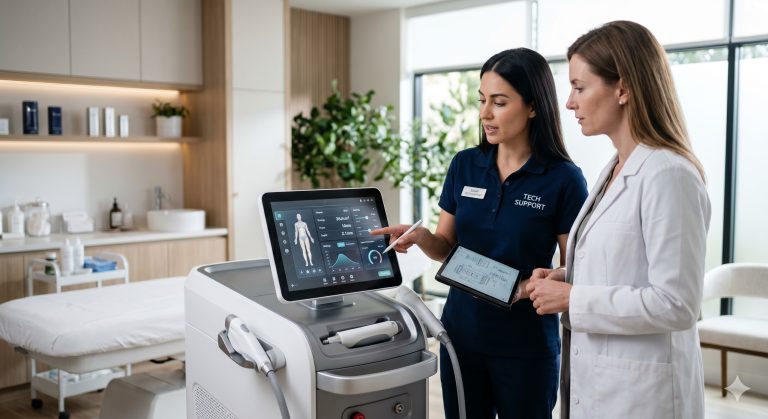
Premium manufacturers offer comprehensive post-sales support, including on-site installation, clinical training for dermatologists, and access to a global service network . Buyers should prioritize vendors with full FDA clearance or CE certification and an ISO 13485 quality management system. This ensures the device meets rigorous engineering standards and is backed by a dedicated support infrastructure .
Q8: What are the key technical specifications (wavelengths, depths) that differentiate these devices?
HIFU utilizes focused ultrasound energy, typically targeting depths of 1.5mm, 3.0mm, and 4.5mm to reach the SMAS layer, with energy delivered in discrete focal points . RF uses electromagnetic heat to target the dermis, with penetration depth varying by type: monopolar RF penetrates deeper (up to 15-20mm) for bulk heating, while bipolar or multipolar RF is more superficial (1-3mm) for texture and mild tightening .