Fractional CO2 laser for acne scars FAQ: Expert Answers for Aesthetic Clinics & Dermatologists
Overview
As a technical support engineer for aesthetic medical devices, I help clinics optimize their investment in the Fractional CO2 laser for acne scars. This FAQ addresses the most critical pre-sales and post-sales questions for B2B buyers—from clinical efficacy on deep scars and machine lifespan to consumable costs and Fitzpatrick skin type suitability. Use these answers to guide your purchase, treatment planning, and maintenance decisions for this gold-standard technology .

Frequently Asked Questions
Q1: Can Fractional CO2 laser effectively remove deep acne ‘ice pick’ scars?
Yes, Fractional CO2 laser is highly effective for deep atrophic acne scars, including ice pick scars . It works by creating microscopic columns of thermal injury that penetrate deep into the dermis to stimulate robust collagen remodeling and neocollagenesis, a process that helps ‘lift’ and fill the scar from the bottom up . A study on multimodal CO2 treatment showed a mean scar volume reduction of 47% , while a combined therapy approach demonstrated a 40.2% median improvement specifically for ice pick scars after 8 weeks . For very deep ice pick scars, a specialized laser punch-out technique can be employed to achieve over 80% depth improvement .
Q2: Is Fractional CO2 laser for acne scars suitable for all Fitzpatrick skin types?
Yes, modern Fractional CO2 lasers are safe and effective for Fitzpatrick skin types I-VI, including darker skin types, when operated with appropriate protocols . However, patients with skin types IV-VI have a significantly higher risk of post-inflammatory hyperpigmentation (PIH) . To safely treat these skin types, clinics must use lower energy densities (e.g., 5-10 mJ), longer pulse widths, and lower coverage densities. Implementing adjunctive pre- and post-treatment protocols, such as melanogenesis inhibitors or specialized peels, is critical to minimize PIH risk . Always perform a test spot 2-4 weeks before full treatment on darker skin to assess individual response .
Q3: How many treatment sessions are typically required for optimal results?
For deep ice pick and other atrophic acne scars, most patients achieve significant improvement in 1 to 3 treatment sessions with a Fractional CO2 laser . While a single session can yield substantial results, the clinical improvement is cumulative. A standard course of treatment is often 3 to 6 sessions spaced 1 to 2 months apart to allow for complete collagen remodeling and skin recovery between treatments .
Q4: What is the typical lifespan of a Fractional CO2 laser handpiece and tube?
The typical lifespan of a medical-grade CO2 laser handpiece is 800,000 to 1.2 million shots before a measurable energy decay of >15% . The sealed CO2 laser tube itself generally lasts 20,000-40,000 shots or 3-5 years under normal clinical use (20-30 treatments/month) . After these limits, output energy drops and spot uniformity degrades, directly impacting clinical efficacy. It is vital to document shot count monthly to plan for timely replacements and maintain consistent treatment results .
Q5: What are the recurring consumable costs for a Fractional CO2 laser?
Annual consumable costs for a Fractional CO2 laser average $800-$2,500 USD per machine . Recurring items include reusable handpiece sapphire windows ($150-300, replace every 50-80 treatments) and disposable patient eye shields ($2-5 per pair) . Other consumables are distilled water for the cooling system (approx. $20/month) and annual tube calibration filters ($200-400) . Notably, the system does not require expensive disposables like single-use tips, making the per-treatment consumable cost very low—often below $2.50 .
Q6: What is the clinical difference between Fractional CO2 laser and other technologies like IPL?
Fractional CO2 laser is ablative and targets deep, atrophic scars by creating micro-columns of thermal injury to stimulate collagen remodeling. It is the gold standard for improving scar texture and depth . In contrast, IPL (Intense Pulsed Light) is non-ablative and only treats redness (post-inflammatory erythema) and superficial pigmentation, not scar texture or pitting. For true clinical improvement of ice pick or other pitted scars, CO2 laser is the indicated treatment, while IPL is not recommended for scar elevation or pitting .
Q7: How often does the Fractional CO2 laser need professional maintenance?
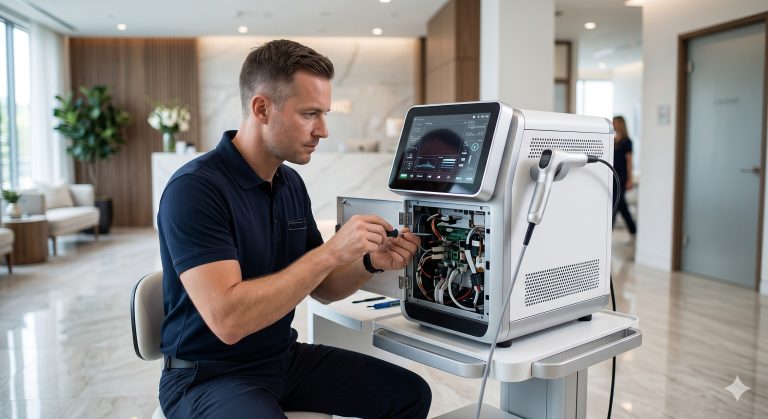
Preventive maintenance for a Fractional CO2 laser is required every 6 months or every 500 shot-hours . This routine includes cleaning or replacing water filters, checking the beam profile with thermal paper, verifying energy output with a power meter (to ensure it is within a ±10% tolerance), and inspecting the articulated arm mirror alignment . A full factory recalibration is recommended every 2 years .
Q8: What B2B post-sales technical support and training is provided?
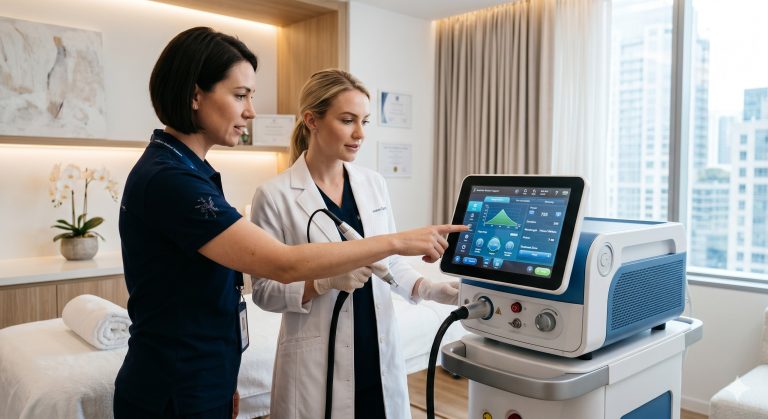
Industry-leading B2B suppliers provide a minimum 24-month warranty on the laser source and scanning system, plus a 12-month warranty on the handpiece and touchscreen UI . Critical post-sales support includes remote diagnostic access (with a response time of <4 business hours), a loaner handpiece for repairs exceeding 5 days, and an online parts portal for rapid shipping of consumables . B2B purchases typically include 2 days of on-site training for up to 4 staff members, covering parameter selection, handpiece sterilization, and emergency protocols, with certificates of competency issued after assessment .