Clinical Architecture & Performance Reference Manual: Ablative vs Non-Ablative Lasers
CLINICAL ARCHITECTURE & PERFORMANCE REFERENCE MANUAL: ABLATIVE VS NON-ABLATIVE LASERS
EXECUTIVE SUMMARY
This document provides a comprehensive, evidence-based comparative analysis of ablative and non-ablative laser technologies within the medical aesthetic device landscape. As a leading OEM manufacturer, we delineate the distinct clinical architectures, treatment paradigms, and performance matrices of these two fundamental classes of laser systems. This overview serves as a definitive guide for dermatology clinics and medical spas seeking to understand the operational, clinical, and patient-outcome implications of each technology.
Ablative lasers, operating primarily at wavelengths such as 10,600nm (CO2) and 2940nm (Er:YAG), function by vaporizing the epidermis and superficial dermis, inducing a robust wound-healing response. This mechanism yields significant improvements in deep rhytids, atrophic scars, and photodamage but entails a longer, more intensive recovery period. Conversely, non-ablative lasers, typically operating in the 532nm to 1550nm range, generate targeted photothermolysis in the dermis while preserving the stratum corneum, facilitating dermal remodeling with minimal downtime. These devices are optimally deployed for vascular lesions, pigmented disorders, and mild-to-moderate skin laxity. This whitepaper details the internal hardware distinctions, cooling mechanisms, and clinical workflows essential for effective system integration.
 CLINICAL ARCHITECTURE & DESIGN
HARDWARE TOPOLOGY AND OPTICAL SOURCE
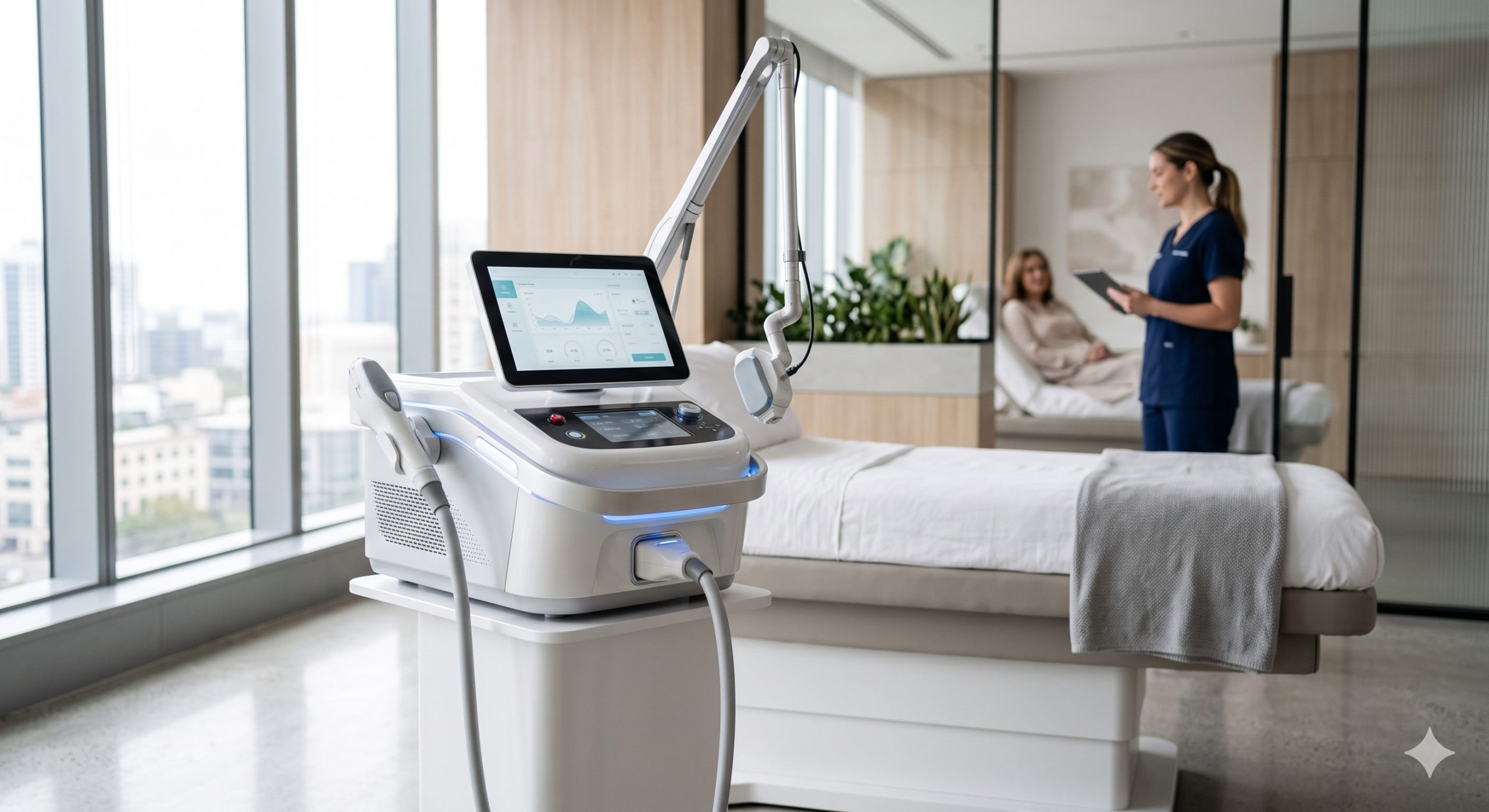
Our comparative analysis begins with a detailed examination of the internal hardware topology. Ablative systems utilize a sealed-tube CO2 or solid-state Er:YAG laser resonator, requiring a high-voltage power supply and a complex gas or crystal-based gain medium. The optical delivery train often incorporates articulated arms with a series of mirrors to guide the high-energy beam to the handpiece. This design results in a larger chassis footprint to accommodate the required optics, power supplies, and advanced water-cooling systems necessary for thermal dissipation. The distinct energy profiles of these ablative wavelengths demand specialized, heavily duty handpieces equipped with high-damage-threshold optics.
In contrast, modern non-ablative systems frequently employ a diode-based architecture, which offers significant advantages in compactness and electrical efficiency. Diode laser bars, such as 808nm or 1064nm configurations, provide exceptional wall-plug efficiency, minimizing the required heat sink size and enabling a more streamlined, lightweight handpiece. The beam delivery is typically facilitated via a highly flexible fiber optic cable, a critical component that enhances ergonomics and treatment versatility. Non-ablative systems often integrate multiple wavelengths (e.g., 755nm, 808nm, 1064nm) within a single platform, allowing clinicians to customize treatment depth and chromophore affinity without a hardware swap, a paradigm that underscores our commitment to modular, future-proof design. The precision of the beam profile is achieved through diffractive optical elements, which homogenize the energy delivery, ensuring a consistent spot shape and energy density across the treatment area.
KEY INDICATIONS & CAPABILITIES
Ablative laser resurfacing remains the gold standard for severe photodamage and deep rhytids. Its capability to ablate tissue layers stimulates a profound neocollagenesis and elastin reorganization, resulting in outcomes that are unparalleled in their degree of correction. Typical clinical applications include deep perioral and periorbital wrinkles, acne scars, surgical scars, and extensive actinic damage. The treatment efficacy, however, is traded against a higher risk of adverse events, including extended erythema, edema, post-inflammatory hyperpigmentation (PIH), and a risk of infection, which demands rigorous post-procedural wound care protocols.
Non-ablative lasers are deployed as the superior choice for patients seeking noticeable rejuvenation without significant social downtime. Their capacity to preserve the epidermal barrier enables their application across a broader range of phototypes, including darker skin tones (Fitzpatrick IV-VI), provided appropriate parameter selection and dynamic cooling are employed. Indications range from telangiectasia, pigmented lesions, and melasma to the stimulation of dermal collagen for a generalized improvement in skin tone and texture. The versatility of multi-wavelength non-ablative platforms allows for customized treatments, from superficial pigment clearance to deep dermal heating for mild skin laxity. This class of device is a cornerstone of the modern medi-spa, offering high patient satisfaction, safety, and operational efficiency.
COMPLIANCE & STANDARDS
Both ablative and non-ablative variants within our portfolio are engineered to meet the rigorous demands of international medical device regulations. All systems conform to IEC 60601-2-22 for medical laser equipment, ensuring comprehensive electrical and optical safety measures. Our manufacturing processes are certified under ISO 13485, and all devices carry the CE mark and are cleared for clinical use by the U.S. Food and Drug Administration (FDA).
TECHNICAL SPECIFICATIONS
Table 1 provides a comparative summary of the core technical parameters differentiating our flagship ablative and non-ablative platforms. The distinction in wavelength, spot size, and cooling mechanisms directly influences the clinical workflow and patient outcomes.
CLINICAL ARCHITECTURE & DESIGN
HARDWARE TOPOLOGY AND OPTICAL SOURCE
Our comparative analysis begins with a detailed examination of the internal hardware topology. Ablative systems utilize a sealed-tube CO2 or solid-state Er:YAG laser resonator, requiring a high-voltage power supply and a complex gas or crystal-based gain medium. The optical delivery train often incorporates articulated arms with a series of mirrors to guide the high-energy beam to the handpiece. This design results in a larger chassis footprint to accommodate the required optics, power supplies, and advanced water-cooling systems necessary for thermal dissipation. The distinct energy profiles of these ablative wavelengths demand specialized, heavily duty handpieces equipped with high-damage-threshold optics.
In contrast, modern non-ablative systems frequently employ a diode-based architecture, which offers significant advantages in compactness and electrical efficiency. Diode laser bars, such as 808nm or 1064nm configurations, provide exceptional wall-plug efficiency, minimizing the required heat sink size and enabling a more streamlined, lightweight handpiece. The beam delivery is typically facilitated via a highly flexible fiber optic cable, a critical component that enhances ergonomics and treatment versatility. Non-ablative systems often integrate multiple wavelengths (e.g., 755nm, 808nm, 1064nm) within a single platform, allowing clinicians to customize treatment depth and chromophore affinity without a hardware swap, a paradigm that underscores our commitment to modular, future-proof design. The precision of the beam profile is achieved through diffractive optical elements, which homogenize the energy delivery, ensuring a consistent spot shape and energy density across the treatment area.
KEY INDICATIONS & CAPABILITIES
Ablative laser resurfacing remains the gold standard for severe photodamage and deep rhytids. Its capability to ablate tissue layers stimulates a profound neocollagenesis and elastin reorganization, resulting in outcomes that are unparalleled in their degree of correction. Typical clinical applications include deep perioral and periorbital wrinkles, acne scars, surgical scars, and extensive actinic damage. The treatment efficacy, however, is traded against a higher risk of adverse events, including extended erythema, edema, post-inflammatory hyperpigmentation (PIH), and a risk of infection, which demands rigorous post-procedural wound care protocols.
Non-ablative lasers are deployed as the superior choice for patients seeking noticeable rejuvenation without significant social downtime. Their capacity to preserve the epidermal barrier enables their application across a broader range of phototypes, including darker skin tones (Fitzpatrick IV-VI), provided appropriate parameter selection and dynamic cooling are employed. Indications range from telangiectasia, pigmented lesions, and melasma to the stimulation of dermal collagen for a generalized improvement in skin tone and texture. The versatility of multi-wavelength non-ablative platforms allows for customized treatments, from superficial pigment clearance to deep dermal heating for mild skin laxity. This class of device is a cornerstone of the modern medi-spa, offering high patient satisfaction, safety, and operational efficiency.
COMPLIANCE & STANDARDS
Both ablative and non-ablative variants within our portfolio are engineered to meet the rigorous demands of international medical device regulations. All systems conform to IEC 60601-2-22 for medical laser equipment, ensuring comprehensive electrical and optical safety measures. Our manufacturing processes are certified under ISO 13485, and all devices carry the CE mark and are cleared for clinical use by the U.S. Food and Drug Administration (FDA).
TECHNICAL SPECIFICATIONS
Table 1 provides a comparative summary of the core technical parameters differentiating our flagship ablative and non-ablative platforms. The distinction in wavelength, spot size, and cooling mechanisms directly influences the clinical workflow and patient outcomes.
CLINICAL PROTOCOLS
TREATMENT PARAMETER REGISTER
The clinical efficacy of any laser system is intrinsically linked to the precise application of treatment parameters. For ablative systems, we recommend a fractional approach, wherein the beam is divided into an array of microscopic treatment zones, leaving intervening zones of healthy tissue to expedite healing. Our ablative platforms feature variable pulse durations and energy levels, enabling the clinician to adjust the depth of ablation from a superficial peel to a deeper resurfacing. The typical protocol for CO2 laser resurfacing initiates at 10-20 W with a pulse duration of 1-2 milliseconds. A key element of our design is a sophisticated integration with a vacuum-assisted or forced-air cooling system integrated into the handpiece to mitigate thermal buildup in the non-targeted tissue.
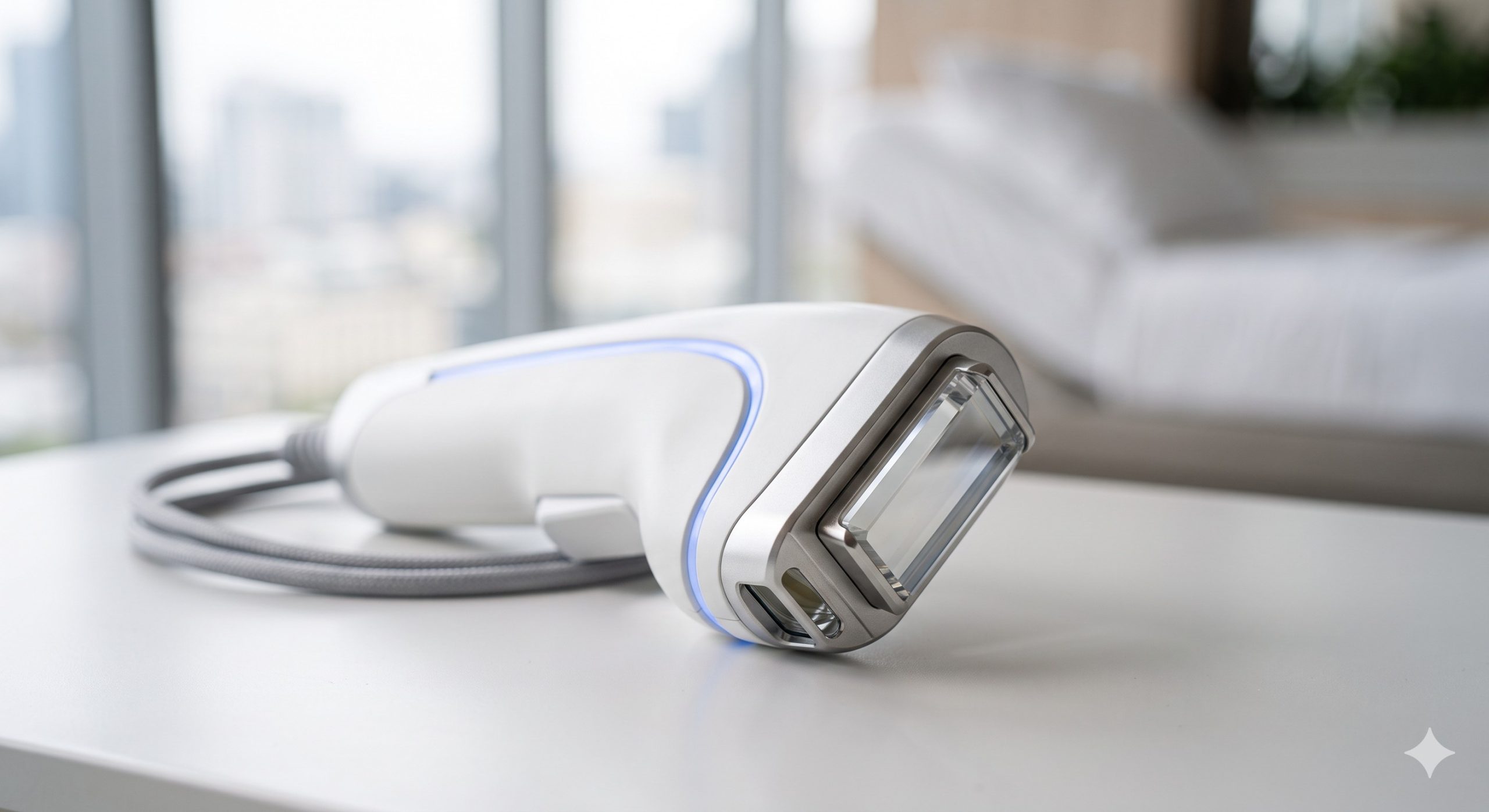
For non-ablative systems, the paradigm shifts to selective photothermolysis with epidermal protection. Our non-ablative platform’s advanced cooling mechanics—a synergistic combination of direct-contact sapphire chilling, thermoelectric cooling (TEC) down to -6°C, and internal water circulation—ensures that the epidermis remains below the threshold for thermal damage while the target chromophore is heated. This permits the use of higher fluences (J/cm²) for deeper tissue effect. For example, a 1064nm Nd:YAG treatment for leg veins would involve a large spot size (e.g., 10mm) with a fluence of up to 120 J/cm² and a longer pulse width (10-40ms) to allow for gradual heating and coagulation of the vessel. Our Smart UI system integrates a skin-type algorithm that automatically adjusts parameters to ensure a “painless” treatment experience, as detailed in the image below.
CLINICAL ARCHITECTURE & DESIGN
HARDWARE TOPOLOGY AND OPTICAL SOURCE
Our comparative analysis begins with a detailed examination of the internal hardware topology. Ablative systems utilize a sealed-tube CO2 or solid-state Er:YAG laser resonator, requiring a high-voltage power supply and a complex gas or crystal-based gain medium. The optical delivery train often incorporates articulated arms with a series of mirrors to guide the high-energy beam to the handpiece. This design results in a larger chassis footprint to accommodate the required optics, power supplies, and advanced water-cooling systems necessary for thermal dissipation. The distinct energy profiles of these ablative wavelengths demand specialized, heavily duty handpieces equipped with high-damage-threshold optics.
In contrast, modern non-ablative systems frequently employ a diode-based architecture, which offers significant advantages in compactness and electrical efficiency. Diode laser bars, such as 808nm or 1064nm configurations, provide exceptional wall-plug efficiency, minimizing the required heat sink size and enabling a more streamlined, lightweight handpiece. The beam delivery is typically facilitated via a highly flexible fiber optic cable, a critical component that enhances ergonomics and treatment versatility. Non-ablative systems often integrate multiple wavelengths (e.g., 755nm, 808nm, 1064nm) within a single platform, allowing clinicians to customize treatment depth and chromophore affinity without a hardware swap, a paradigm that underscores our commitment to modular, future-proof design. The precision of the beam profile is achieved through diffractive optical elements, which homogenize the energy delivery, ensuring a consistent spot shape and energy density across the treatment area.
KEY INDICATIONS & CAPABILITIES
Ablative laser resurfacing remains the gold standard for severe photodamage and deep rhytids. Its capability to ablate tissue layers stimulates a profound neocollagenesis and elastin reorganization, resulting in outcomes that are unparalleled in their degree of correction. Typical clinical applications include deep perioral and periorbital wrinkles, acne scars, surgical scars, and extensive actinic damage. The treatment efficacy, however, is traded against a higher risk of adverse events, including extended erythema, edema, post-inflammatory hyperpigmentation (PIH), and a risk of infection, which demands rigorous post-procedural wound care protocols.
Non-ablative lasers are deployed as the superior choice for patients seeking noticeable rejuvenation without significant social downtime. Their capacity to preserve the epidermal barrier enables their application across a broader range of phototypes, including darker skin tones (Fitzpatrick IV-VI), provided appropriate parameter selection and dynamic cooling are employed. Indications range from telangiectasia, pigmented lesions, and melasma to the stimulation of dermal collagen for a generalized improvement in skin tone and texture. The versatility of multi-wavelength non-ablative platforms allows for customized treatments, from superficial pigment clearance to deep dermal heating for mild skin laxity. This class of device is a cornerstone of the modern medi-spa, offering high patient satisfaction, safety, and operational efficiency.
COMPLIANCE & STANDARDS
Both ablative and non-ablative variants within our portfolio are engineered to meet the rigorous demands of international medical device regulations. All systems conform to IEC 60601-2-22 for medical laser equipment, ensuring comprehensive electrical and optical safety measures. Our manufacturing processes are certified under ISO 13485, and all devices carry the CE mark and are cleared for clinical use by the U.S. Food and Drug Administration (FDA).
TECHNICAL SPECIFICATIONS
Table 1 provides a comparative summary of the core technical parameters differentiating our flagship ablative and non-ablative platforms. The distinction in wavelength, spot size, and cooling mechanisms directly influences the clinical workflow and patient outcomes.
| Parameter | Ablative Laser (CO2/Er:YAG) | Non-Ablative Laser (Diode/Nd:YAG) |
|---|---|---|
| Primary Wavelengths | 10,600nm (CO2) / 2,940nm (Er:YAG) | 808nm / 1,064nm (Nd:YAG) / 755nm |
| Energy Delivery Mechanism | High-Energy Pulsed / Scanned (Fractional) | Continuous Wave / Quasi-CW (Pulsed) |
| Spot Size Range | 0.1mm – 1.5mm (Focus) | 2mm – 15mm (Variable / Multi-Spot) |
| Cooling System Architecture | Forced Air / Cryogen Spray (Integrated) | Sapphire Contact Cooling + TEC + Water Circulation |
| Epidermal Preservation | None (Ablation) | Complete (Dynamic Cooling) |
| Typical Fluence (J/cm²) | 5 – 50 J/cm² (Varies by mode) | 10 – 120 J/cm² |
| Downtime | 5 – 14 Days | 0 – 2 Days |
| Primary Indications | Deep Wrinkles, Scars, Severe Photodamage | Vascular Lesions, Pigmentation, Mild Laxity |
📥 Download Technical Specification
Click the button below to view or download the full official PDF datasheet.
⬇️ Download Official PDF