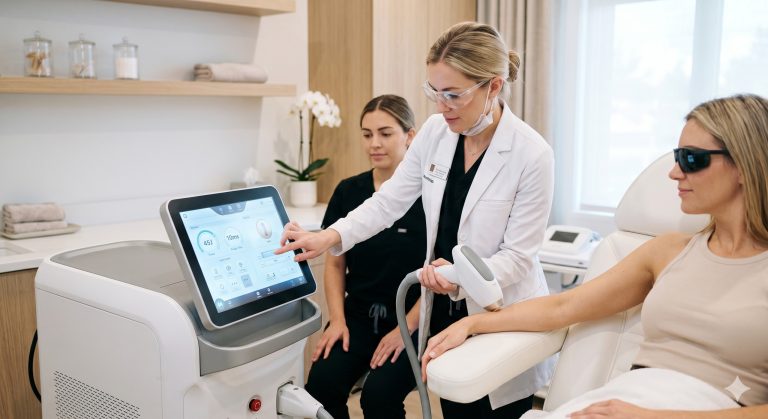
Hardware & Engineering FAQ: Wavelengths, Spot Sizes, and Energy of Diode Lasers for Hair Removal
Overview
For clinic owners and dermatologists, balancing spot size and fluence is the single most critical engineering decision to maximize patient throughput without compromising safety. A larger spot size penetrates deeper but requires proportional energy adjustments. This technical FAQ addresses how to optimize laser hair removal speed by understanding the inverse relationship between spot size and fluence, ensuring both clinical efficacy and faster treatment times.
Frequently Asked Questions
Q1: What is the inverse relationship between spot size and fluence in diode laser hair removal?
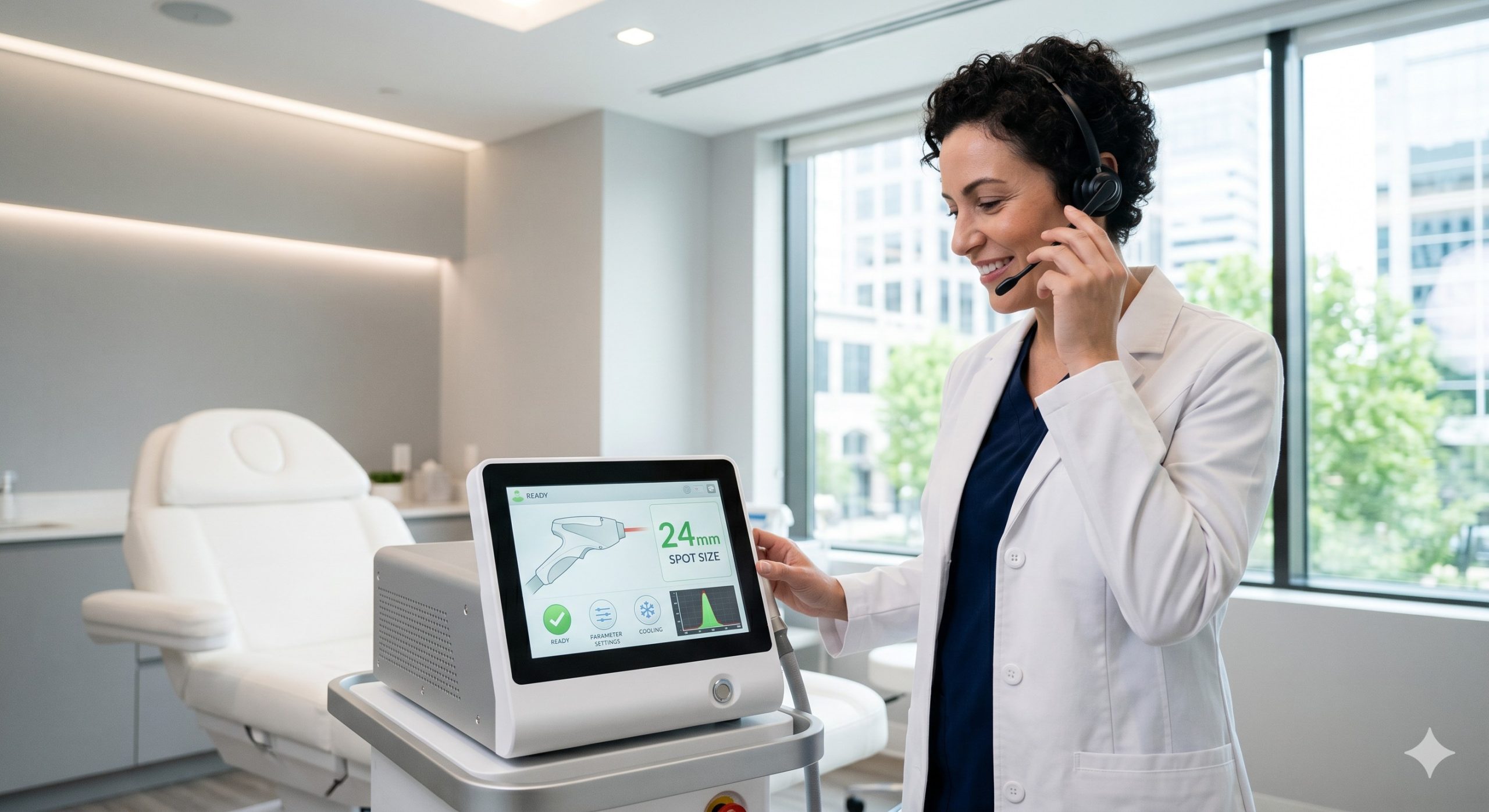
Fluence must decrease as spot size increases to maintain a safe and effective energy density. Specifically, if you double the spot diameter, the beam area quadruples, requiring a proportional reduction in fluence (J/cm²) to avoid overheating the dermis. For example, a 24mm spot size typically operates at 10-12 J/cm², whereas a 12mm spot may require 20-24 J/cm² for the same clinical endpoint. This relationship is governed by the principle of selective photothermolysis: larger spots scatter less light and penetrate deeper, so lower fluence achieves the same thermal effect on the follicle bulb.
Q2: How does increasing spot size directly improve laser hair removal speed and clinic throughput?
A larger spot size reduces total treatment time by a factor equal to the area increase per pulse. For a 24mm spot (area ~4.5 cm²) versus a 12mm spot (area ~1.1 cm²), each pulse covers four times more skin. Clinically, a full leg treatment drops from 45 minutes with a 12mm handpiece to under 12 minutes with a 24mm spot. This 4x speed increase allows clinics to double or triple daily patient volume, directly improving ROI without purchasing additional equipment.
Q3: Can I use a high fluence with a large spot size to get even faster results?
No, exceeding fluence limits for a given spot size causes thermal injury, pain, and paradoxical hypertrichosis. Every diode laser has a maximum safe radiant exposure (J/cm²) inversely calibrated to spot size. Attempting 20 J/cm² through a 24mm spot delivers 80J total energy per pulse—four times the thermal load of a 12mm spot at the same fluence. This overheats the epidermis, bypasses contact cooling efficacy, and risks burns on Fitzpatrick IV-VI skin. Always adhere to manufacturer fluence-spot size matrices: large spots require low-to-medium fluence (8-14 J/cm²), while small spots allow medium-to-high fluence (18-30 J/cm²).
Q4: What is the optimal spot size for fast treatment on Fitzpatrick V-VI skin types?
The optimal spot size for dark skin (Fitzpatrick V-VI) is 18-22mm with low fluence (8-11 J/cm²) and a 940nm or 1060nm diode wavelength. Large spots reduce peak energy density while maintaining deep follicular heating, minimizing epidermal melanin absorption. Smaller spots (12mm or less) concentrate energy, increasing the risk of post-inflammatory hyperpigmentation. For safe, fast treatments on dark skin, prioritize a 20-24mm spot size with aggressive sapphire contact cooling (-5°C to 0°C) to protect the basal layer.
Q5: How do I calculate the theoretical time savings when upgrading to a larger spot size handpiece?
Time savings = 1 – (Area_small / Area_large). Calculate area using π × (radius)². For a 12mm spot (radius 6mm, area = 113 mm²) versus an 24mm spot (radius 12mm, area = 452 mm²), the ratio is 113/452 = 0.25, so time savings = 75%. More precisely, if a full back takes 800 pulses with a 12mm spot, it takes only 200 pulses with a 24mm spot. Apply this formula: New Treatment Time = Old Treatment Time × (SpotSize_Small² / SpotSize_Large²). Always add 10-15% for anatomical contours and overlapping requirements.
Q6: Does a larger spot size reduce patient pain compared to a small spot at equivalent clinical efficacy?
Yes, larger spot sizes typically cause less pain when fluence is correctly down-regulated. Pain correlates with peak epidermal energy density. A 24mm spot at 10 J/cm² delivers energy over a wider area, so the thermal shock per nerve ending is lower than a 12mm spot at 20 J/cm². Additionally, larger spots allow faster handpiece gliding, reducing the “stinging” sensation of stationary pulses. Clinical studies show patient-reported pain scores (0-10 VAS) drop from 6-7 with 12mm spots to 3-4 with 22-24mm spots for equivalent hair reduction.
Q7: What is the realistic maximum spot size before anatomical limitations reduce efficiency?
The practical maximum spot size for body treatments is 24-25mm. Spots larger than 25mm cannot maintain uniform contact on curved anatomy (shins, chins, underarms, bikini line) due to reduced surface compliance. When a 30mm handpiece bridges over bony prominences, energy drops by 40-60% because the sapphire window loses perpendicular tissue contact. For flat areas (back, thighs, chest), 24mm remains optimal. For facial or contour treatments, a secondary 12-15mm handpiece is recommended. Never purchase a laser with a single fixed spot size >25mm unless you treat only flat surfaces.
Q8: How do I choose between a fixed large spot versus a variable spot size handpiece for my clinic?
Choose a variable spot size handpiece (12mm, 18mm, 24mm selectable) if your clinic treats mixed body areas and skin types. A fixed 24mm excels for high-volume leg/back/chest clinics with Fitzpatrick I-IV, but fails for small anatomical zones (upper lip, areola, fingers). Conversely, fixed 15mm offers versatility but sacrifices 50% speed on large areas. The ROI calculation: variable handpiece adds $2,000-5,000 to capital cost but reduces total treatment time across your service menu by 40%, typically recovering the premium in 3-6 months of operation.