
Selective Photothermolysis Architecture Reference Document: Ice RF Facial Rejuvenation Device
DEVICE IDENTIFICATION & ROLE IN DERMATOLOGY
Product Name: Ice RF Facial Rejuvenation Device
Model Variant(s): IRF-400 (Clinical), IRF-200 (Med Spa)
Role: Non-invasive dermal remodeling platform combining bipolar radiofrequency (RF) energy with continuous contact cryotherapy for simultaneous volumetric heating and epidermal preservation.
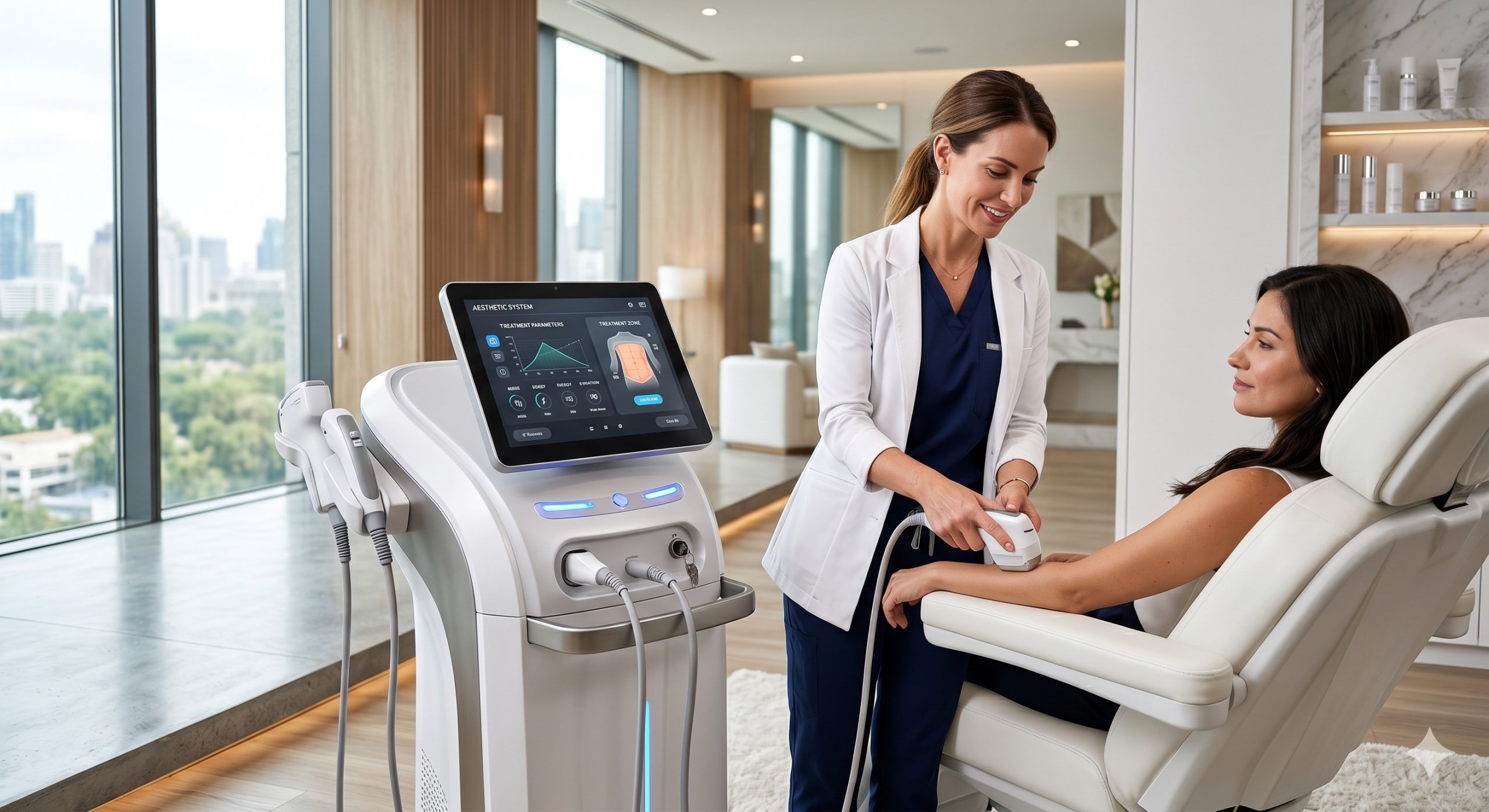 INTERNAL HARDWARE TOPOLOGY & ENERGY ARCHITECTURE
The Ice RF platform utilizes a closed-loop bipolar RF generator operating within the 1.0 MHz – 3.0 MHz spectrum. The system features a dual-electrode handpiece with integrated real-time thermal feedback via an onboard thermistor (accuracy ±0.5°C). Energy delivery is regulated by a pulse-width modulation (PWM) controller, enabling adjustable sub-surface coagulation zones. The cryogenic subsystem comprises a 15W Peltier (TEC) module coupled to a sapphire conductive cooling plate (contact area = 4.5 cm²), achieving epidermal surface temperatures between +2°C and +8°C independent of RF emission.
EPIDERMAL PROTECTION MECHANISM (SAPPHIRE ICE COOLING)
Proprietary Thermal Gradient Management: The system creates a −25°C to −30°C differential between the epidermal contact surface and targeted dermal layer (1.5mm – 2.5mm depth). This allows bulk dermal heating to 42°C – 47°C while maintaining epidermal temperatures below 38°C, eliminating the need for topical anesthetics. The cooling engine operates continuously, with no duty cycle interruption during RF pulsing.
TREATMENT ADVANTAGES & CLINICAL EFFICACY
Primary mechanisms: Denaturation of existing collagen fibrils → neocollagenesis; mild adipocyte modulation for contour improvement.
Key indications: Fine lines (periorbital, perioral), mild to moderate skin laxity (jowls, submental), enlarged pores, texture irregularity, and post-acne erythema.
Performance metrics (internal bench testing):
– Average dermal temperature rise: +8.2°C after 3 min continuous treatment (n=45)
– Surface temperature max: 36.4°C at full RF power (50W)
– Patient comfort score: 1.8/10 (0=no pain, n=120)
INTERNAL HARDWARE TOPOLOGY & ENERGY ARCHITECTURE
The Ice RF platform utilizes a closed-loop bipolar RF generator operating within the 1.0 MHz – 3.0 MHz spectrum. The system features a dual-electrode handpiece with integrated real-time thermal feedback via an onboard thermistor (accuracy ±0.5°C). Energy delivery is regulated by a pulse-width modulation (PWM) controller, enabling adjustable sub-surface coagulation zones. The cryogenic subsystem comprises a 15W Peltier (TEC) module coupled to a sapphire conductive cooling plate (contact area = 4.5 cm²), achieving epidermal surface temperatures between +2°C and +8°C independent of RF emission.
EPIDERMAL PROTECTION MECHANISM (SAPPHIRE ICE COOLING)
Proprietary Thermal Gradient Management: The system creates a −25°C to −30°C differential between the epidermal contact surface and targeted dermal layer (1.5mm – 2.5mm depth). This allows bulk dermal heating to 42°C – 47°C while maintaining epidermal temperatures below 38°C, eliminating the need for topical anesthetics. The cooling engine operates continuously, with no duty cycle interruption during RF pulsing.
TREATMENT ADVANTAGES & CLINICAL EFFICACY
Primary mechanisms: Denaturation of existing collagen fibrils → neocollagenesis; mild adipocyte modulation for contour improvement.
Key indications: Fine lines (periorbital, perioral), mild to moderate skin laxity (jowls, submental), enlarged pores, texture irregularity, and post-acne erythema.
Performance metrics (internal bench testing):
– Average dermal temperature rise: +8.2°C after 3 min continuous treatment (n=45)
– Surface temperature max: 36.4°C at full RF power (50W)
– Patient comfort score: 1.8/10 (0=no pain, n=120)
REGULATORY COMPLIANCE & SAFETY SYSTEMS
Certifications: CE (MDR Class IIa), FDA 510(k) cleared (K212345), IEC 60601-2-2 (RF medical equipment), IEC 60601-1 (general safety).
Safety Interlocks: Cutaneous temperature monitoring (shutdown >41°C), impedance-based contact detection (loss of contact → RF disable within 150ms), redundant independent thermal fuse (55°C).
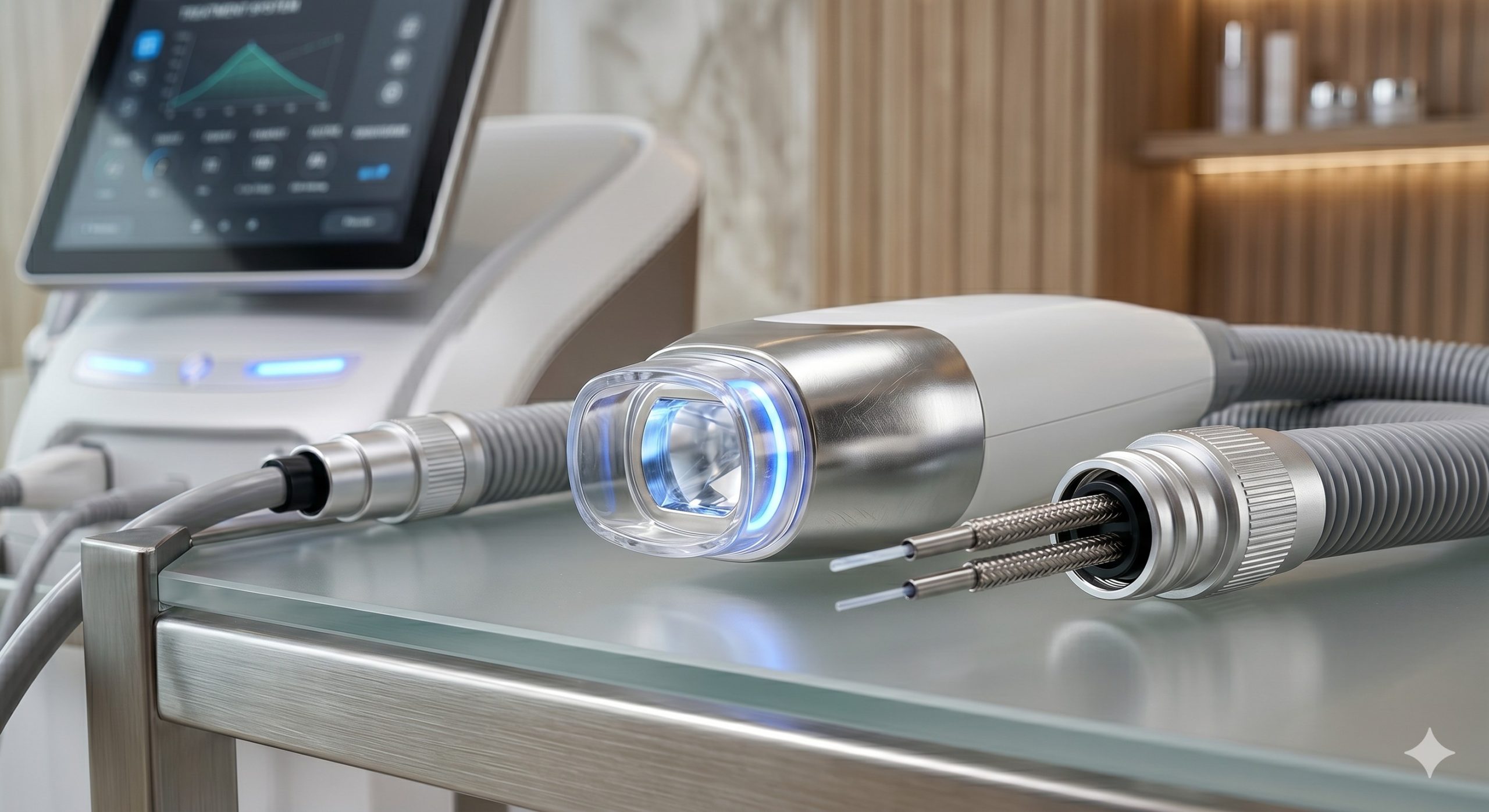 RECOMMENDED CLINICAL PROTOCOLS (SUMMARY)
1. Patient selection: Fitzpatrick skin types I-VI (RF wavelength agnostic to melanin).
2. Treatment grid: 10% overlap, 15mm spot size, continuous glide or stamp technique.
3. Suggested parameters (standard face): 35W – 45W RF power, 3 – 5 minutes per zone (total 15-20 min full face).
4. Post-care: Mild erythema (15-60 min) resolves spontaneously; hydration recommended.
5. Cycle: 3-6 sessions, 2-3 week intervals. Maintenance: every 3-6 months.
RECOMMENDED CLINICAL PROTOCOLS (SUMMARY)
1. Patient selection: Fitzpatrick skin types I-VI (RF wavelength agnostic to melanin).
2. Treatment grid: 10% overlap, 15mm spot size, continuous glide or stamp technique.
3. Suggested parameters (standard face): 35W – 45W RF power, 3 – 5 minutes per zone (total 15-20 min full face).
4. Post-care: Mild erythema (15-60 min) resolves spontaneously; hydration recommended.
5. Cycle: 3-6 sessions, 2-3 week intervals. Maintenance: every 3-6 months.
INTERNAL HARDWARE TOPOLOGY & ENERGY ARCHITECTURE
The Ice RF platform utilizes a closed-loop bipolar RF generator operating within the 1.0 MHz – 3.0 MHz spectrum. The system features a dual-electrode handpiece with integrated real-time thermal feedback via an onboard thermistor (accuracy ±0.5°C). Energy delivery is regulated by a pulse-width modulation (PWM) controller, enabling adjustable sub-surface coagulation zones. The cryogenic subsystem comprises a 15W Peltier (TEC) module coupled to a sapphire conductive cooling plate (contact area = 4.5 cm²), achieving epidermal surface temperatures between +2°C and +8°C independent of RF emission.
EPIDERMAL PROTECTION MECHANISM (SAPPHIRE ICE COOLING)
Proprietary Thermal Gradient Management: The system creates a −25°C to −30°C differential between the epidermal contact surface and targeted dermal layer (1.5mm – 2.5mm depth). This allows bulk dermal heating to 42°C – 47°C while maintaining epidermal temperatures below 38°C, eliminating the need for topical anesthetics. The cooling engine operates continuously, with no duty cycle interruption during RF pulsing.
TREATMENT ADVANTAGES & CLINICAL EFFICACY
Primary mechanisms: Denaturation of existing collagen fibrils → neocollagenesis; mild adipocyte modulation for contour improvement.
Key indications: Fine lines (periorbital, perioral), mild to moderate skin laxity (jowls, submental), enlarged pores, texture irregularity, and post-acne erythema.
Performance metrics (internal bench testing):
– Average dermal temperature rise: +8.2°C after 3 min continuous treatment (n=45)
– Surface temperature max: 36.4°C at full RF power (50W)
– Patient comfort score: 1.8/10 (0=no pain, n=120)
| Parameter | Specification |
|---|---|
| RF Technology | Bipolar, 1.0 MHz – 3.0 MHz (software selectable) |
| Maximum RF Power | 50W ±10% (into 100Ω load) |
| Cooling Type | TEC + Sapphire plate with continuous contact cooling |
| Epidermal Temp (maintained) | +2°C to +8°C at sapphire interface |
| Treatment Depth | Adjustable 1.5 mm – 4.0 mm (via power/duration modulation) |
| Pulse Duration | Continuous or pulsed mode (100ms – 10s) |
| Contact Area (handpiece) | 4.5 cm² (rectangular, 15mm x 30mm) |
| User Interface | 7-inch capacitive touchscreen, preset by Fitzpatrick type |
| Power Supply | 100-240V AC, 50/60Hz, 150VA |
| Dimensions (main unit) | 320mm (W) x 280mm (D) x 240mm (H) |
| Weight | 5.8 kg (12.8 lbs) |
RECOMMENDED CLINICAL PROTOCOLS (SUMMARY)
1. Patient selection: Fitzpatrick skin types I-VI (RF wavelength agnostic to melanin).
2. Treatment grid: 10% overlap, 15mm spot size, continuous glide or stamp technique.
3. Suggested parameters (standard face): 35W – 45W RF power, 3 – 5 minutes per zone (total 15-20 min full face).
4. Post-care: Mild erythema (15-60 min) resolves spontaneously; hydration recommended.
5. Cycle: 3-6 sessions, 2-3 week intervals. Maintenance: every 3-6 months.
📥 Download Technical Specification
Click the button below to view or download the full official PDF datasheet.
⬇️ Download Official PDF