Selective Photothermolysis Architecture Reference Document: Q-Switched Nanosecond Laser Workstation
SELECTIVE PHOTOTHERMOLYSIS ARCHITECTURE REFERENCE DOCUMENT: Q-SWITCHED NANOSECOND LASER WORKSTATION
EXECUTIVE SUMMARY
This document provides a comprehensive technical and clinical overview of the Q-Switched Nanosecond Laser Workstation, a premium medical aesthetic device engineered for the precise clearance of dermal and epidermal pigmented lesions, professional tattoo removal, and skin rejuvenation. The platform leverages nanosecond-domain pulse generation to induce selective photothermolysis, ensuring maximal target chromophore destruction with minimized thermal diffusion to surrounding tissues. Designed for high-volume dermatology clinics and medical spas, this workstation integrates advanced solid-state laser resonators, an articulated articulated arm delivery system, and a closed-loop contact cooling engine.
 CLINICAL ARCHITECTURE & DESIGN
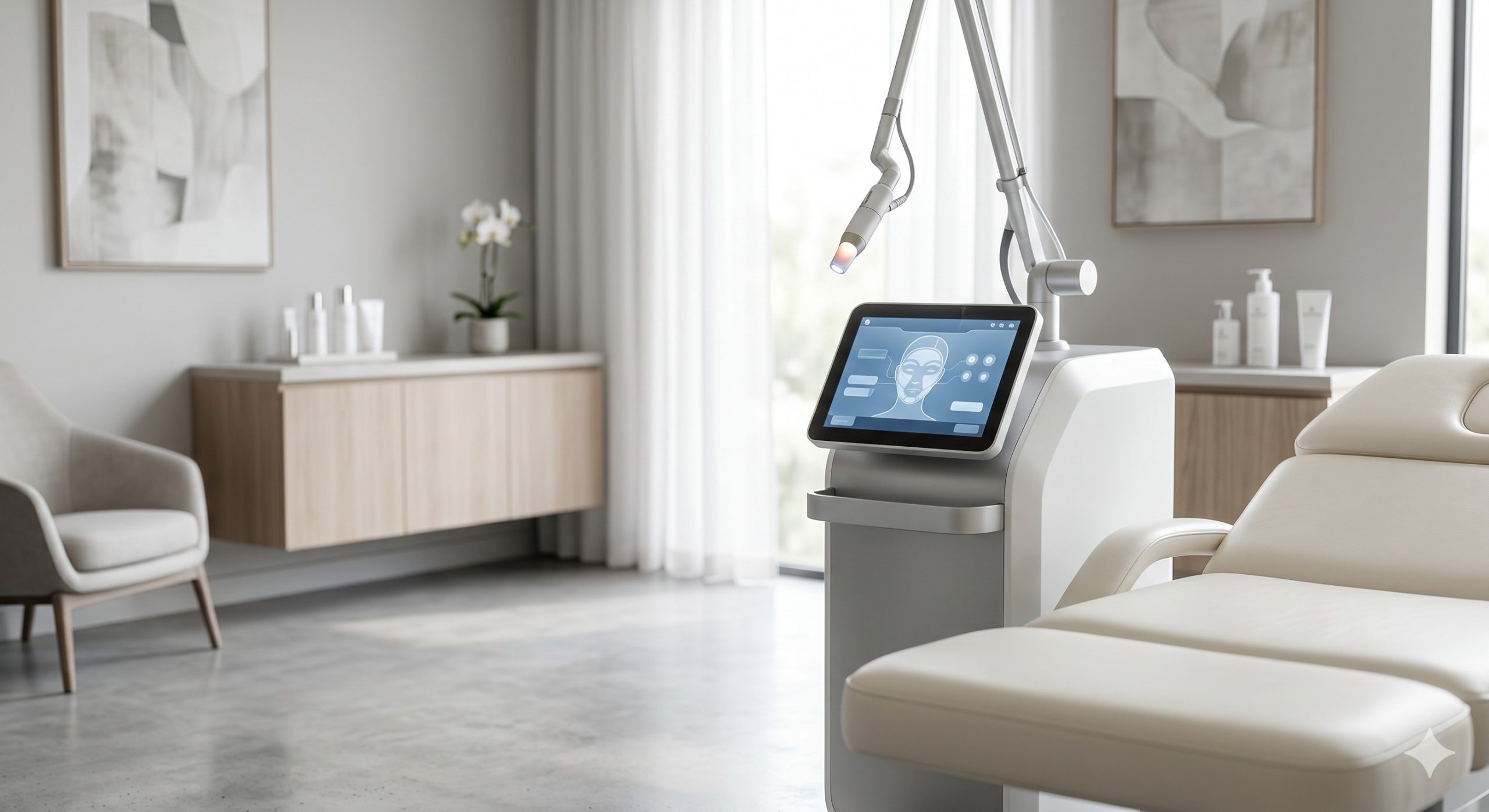
The device architecture prioritizes clinical efficacy and operational longevity. The optical core utilizes high-stability Nd:YAG laser crystals producing fundamental emission at 1064nm, with frequency-doubling optics generating the 532nm wavelength. The Q-switching mechanism (Pockels cell or saturable absorber) compresses the pulse energy into a 5-20 nanosecond window, generating peak powers exceeding 50 MW. The energy is transmitted through a seven-articulation, counter-balanced articulated arm featuring dielectric-coated, high-damage-threshold mirrors to a lightweight ergonomic handpiece. A high-brightness Xenon flashlamp pumps the laser cavity, supported by a recirculating deionized water cooling loop and thermoelectric chillers to maintain optical alignment and flashlamp lifetime.
KEY INDICATIONS & CAPABILITIES
The Q-Switched Nanosecond Laser Workstation is indicated for:
– Professional Tattoo Removal (multi-color, amateur, traumatic)
– Benign Pigmented Lesions (lentigos, ephelides, café au lait, nevi of Ota/Ito)
– Recalcitrant Melasma (adjunctive, low-fluence protocol)
– Acne Scars & Pores (resurfacing via fractional handpiece, optional)
– Photoaged Skin (diffuse erythema, dyschromia)
– Nevus of Ota clearance
CONTRAINDICATIONS: Active local or systemic infection, history of keloid scarring, photosensitivity disorders, anticoagulation therapy, pregnancy, recent tanning, or Fitzpatrick Skin Types V-VI for 532nm (high epidermal melanin risk).
COMPLIANCE & STANDARDS
The workstation is manufactured under ISO 13485:2016 certified facilities and complies with:
– IEC 60825-1:2014 (Class 4 Laser Product safety)
– FDA 21 CFR 1040.10 & 1040.11 (with variance)
– Medical Device Directive 93/42/EEC (CE 0197)
– MDR (EU) 2017/745 Class IIb
– RoHS & REACH environmental directives
Built-in safety features include: aperture shutters, emergency stop, key switch, ready indicator, audible countdown, footswitch interlock, and real-time energy monitoring.
TECHNICAL SPECIFICATIONS
CLINICAL ARCHITECTURE & DESIGN
The device architecture prioritizes clinical efficacy and operational longevity. The optical core utilizes high-stability Nd:YAG laser crystals producing fundamental emission at 1064nm, with frequency-doubling optics generating the 532nm wavelength. The Q-switching mechanism (Pockels cell or saturable absorber) compresses the pulse energy into a 5-20 nanosecond window, generating peak powers exceeding 50 MW. The energy is transmitted through a seven-articulation, counter-balanced articulated arm featuring dielectric-coated, high-damage-threshold mirrors to a lightweight ergonomic handpiece. A high-brightness Xenon flashlamp pumps the laser cavity, supported by a recirculating deionized water cooling loop and thermoelectric chillers to maintain optical alignment and flashlamp lifetime.
KEY INDICATIONS & CAPABILITIES
The Q-Switched Nanosecond Laser Workstation is indicated for:
– Professional Tattoo Removal (multi-color, amateur, traumatic)
– Benign Pigmented Lesions (lentigos, ephelides, café au lait, nevi of Ota/Ito)
– Recalcitrant Melasma (adjunctive, low-fluence protocol)
– Acne Scars & Pores (resurfacing via fractional handpiece, optional)
– Photoaged Skin (diffuse erythema, dyschromia)
– Nevus of Ota clearance
CONTRAINDICATIONS: Active local or systemic infection, history of keloid scarring, photosensitivity disorders, anticoagulation therapy, pregnancy, recent tanning, or Fitzpatrick Skin Types V-VI for 532nm (high epidermal melanin risk).
COMPLIANCE & STANDARDS
The workstation is manufactured under ISO 13485:2016 certified facilities and complies with:
– IEC 60825-1:2014 (Class 4 Laser Product safety)
– FDA 21 CFR 1040.10 & 1040.11 (with variance)
– Medical Device Directive 93/42/EEC (CE 0197)
– MDR (EU) 2017/745 Class IIb
– RoHS & REACH environmental directives
Built-in safety features include: aperture shutters, emergency stop, key switch, ready indicator, audible countdown, footswitch interlock, and real-time energy monitoring.
TECHNICAL SPECIFICATIONS
CLINICAL PROTOCOLS – STANDARD TREATMENT PARAMETERS
TATTOO REMOVAL (BLACK/DARK BLUE): 1064nm, 5-8 J/cm², 5-10 ns, 2-4 mm spot, 4-6 week intervals. Endpoint: immediate whitening (frosting).
TATTOO REMOVAL (RED/ORANGE/YELLOW): 532nm, 2-4 J/cm², 5-10 ns, 2-3 mm spot, 6-8 week intervals. Endpoint: frosting + mild purpura.
LENTIGINES (SOLAR LENTIGO): 532nm, 1.5-2.5 J/cm², 5-10 ns, 3-4 mm spot. Endpoint: immediate darkening (no frosting required).
NEVUS OF OTA: 1064nm, 6-10 J/cm², 5-10 ns, 3-4 mm spot. Multiple sessions (3-8).
CLINICAL WORKFLOW & PATIENT MANAGEMENT
1. PRE-TREATMENT: Informed consent, skin type assessment (Fitzpatrick I-VI), test spot in discreet area (24-48h), topical anesthetic optional (30-60 min).
2. INTRA-TREATMENT: Don appropriate laser safety eyewear. Set fluence 10-15% below purpura threshold. Activate Sapphire cooling (preset to +4°C). Overlap <10%. Deliver pulses at 1-2 Hz.
3. POST-TREATMENT: Apply broad-spectrum SPF 50+ and occlusive dressing (if ablated). Instruct on cold compresses, avoid sun exposure, and no picking of micro-crusts. Adverse events: transient erythema, edema, purpura (532nm), hypo/hyperpigmentation (rare, usually resolves).
CLINICAL ARCHITECTURE & DESIGN
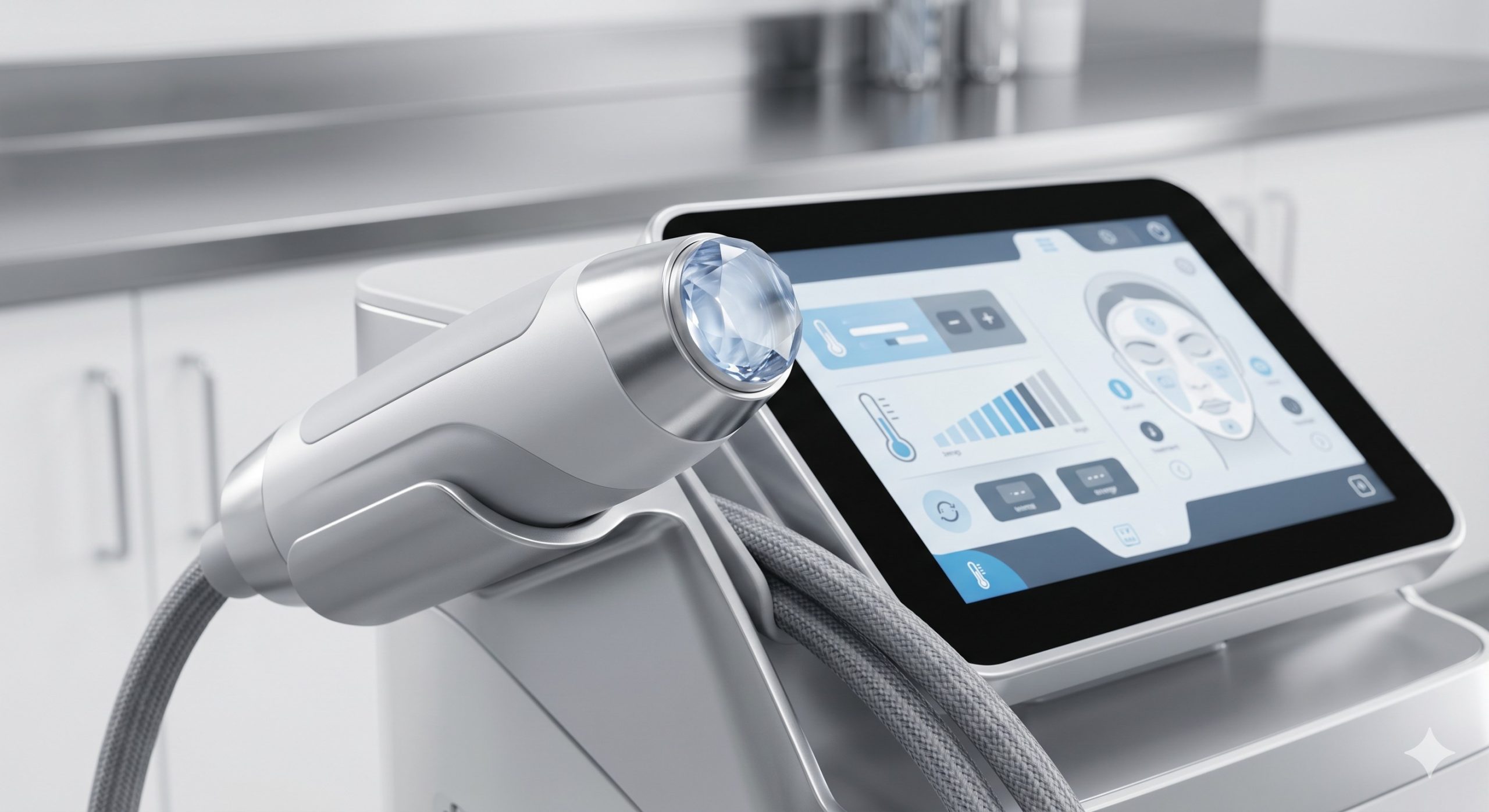
The device architecture prioritizes clinical efficacy and operational longevity. The optical core utilizes high-stability Nd:YAG laser crystals producing fundamental emission at 1064nm, with frequency-doubling optics generating the 532nm wavelength. The Q-switching mechanism (Pockels cell or saturable absorber) compresses the pulse energy into a 5-20 nanosecond window, generating peak powers exceeding 50 MW. The energy is transmitted through a seven-articulation, counter-balanced articulated arm featuring dielectric-coated, high-damage-threshold mirrors to a lightweight ergonomic handpiece. A high-brightness Xenon flashlamp pumps the laser cavity, supported by a recirculating deionized water cooling loop and thermoelectric chillers to maintain optical alignment and flashlamp lifetime.
KEY INDICATIONS & CAPABILITIES
The Q-Switched Nanosecond Laser Workstation is indicated for:
– Professional Tattoo Removal (multi-color, amateur, traumatic)
– Benign Pigmented Lesions (lentigos, ephelides, café au lait, nevi of Ota/Ito)
– Recalcitrant Melasma (adjunctive, low-fluence protocol)
– Acne Scars & Pores (resurfacing via fractional handpiece, optional)
– Photoaged Skin (diffuse erythema, dyschromia)
– Nevus of Ota clearance
CONTRAINDICATIONS: Active local or systemic infection, history of keloid scarring, photosensitivity disorders, anticoagulation therapy, pregnancy, recent tanning, or Fitzpatrick Skin Types V-VI for 532nm (high epidermal melanin risk).
COMPLIANCE & STANDARDS
The workstation is manufactured under ISO 13485:2016 certified facilities and complies with:
– IEC 60825-1:2014 (Class 4 Laser Product safety)
– FDA 21 CFR 1040.10 & 1040.11 (with variance)
– Medical Device Directive 93/42/EEC (CE 0197)
– MDR (EU) 2017/745 Class IIb
– RoHS & REACH environmental directives
Built-in safety features include: aperture shutters, emergency stop, key switch, ready indicator, audible countdown, footswitch interlock, and real-time energy monitoring.
TECHNICAL SPECIFICATIONS
| Parameter | Specification |
|---|---|
| Laser Type / Wavelengths | Q-Switched Nd:YAG / 1064 nm & 532 nm (frequency-doubled) |
| Pulse Width (nominal) | 5 – 20 nanoseconds (FWHM, user-selectable) |
| Peak Power (1064 nm) | > 50 MW (at max fluence, 6 mm spot) |
| Maximum Fluence (1064 nm) | 12 J/cm² (adjustable in 0.1 J/cm² increments) |
| Maximum Fluence (532 nm) | 6 J/cm² (adjustable in 0.1 J/cm² increments) |
| Spot Size Range | 1 mm – 8 mm (continuous zoom or fixed handpiece tips) |
| Repetition Rate | 1 – 10 Hz (single shot to continuous) |
| Energy Stability | ≤ ± 5% over 8 hours (after warm-up) |
| Cooling System | Closed-loop: TEC + Sapphire contact plate (+2°C to +8°C) + recirculating deionized water + fans |
| Delivery System | 7-joint articulated arm, counter-balanced, 160 cm reach |
| Display / UI | 10.4-inch resistive touchscreen, preset protocols for lesion/tattoo type and Fitzpatrick scale |
| Dimensions (W x D x H) | 42 cm x 68 cm x 98 cm (console only) |
| Weight (console) | 68 kg (150 lbs) |
| Electrical Requirements | 200-240 VAC, 50/60 Hz, 15A, single-phase |
| Laser Class | Class 4 (IEC 60825-1) |
| Operating Environment | 15°C – 30°C, 30% – 75% relative humidity (non-condensing) |
| Warranty (Standard) | Laser head: 24 months / System: 12 months parts & labor |
📥 Download Technical Specification
Click the button below to view or download the full official PDF datasheet.
⬇️ Download Official PDF