
Ablative vs Non-Ablative Laser – Official Clinical Overview & Datasheet
EXECUTIVE SUMMARY
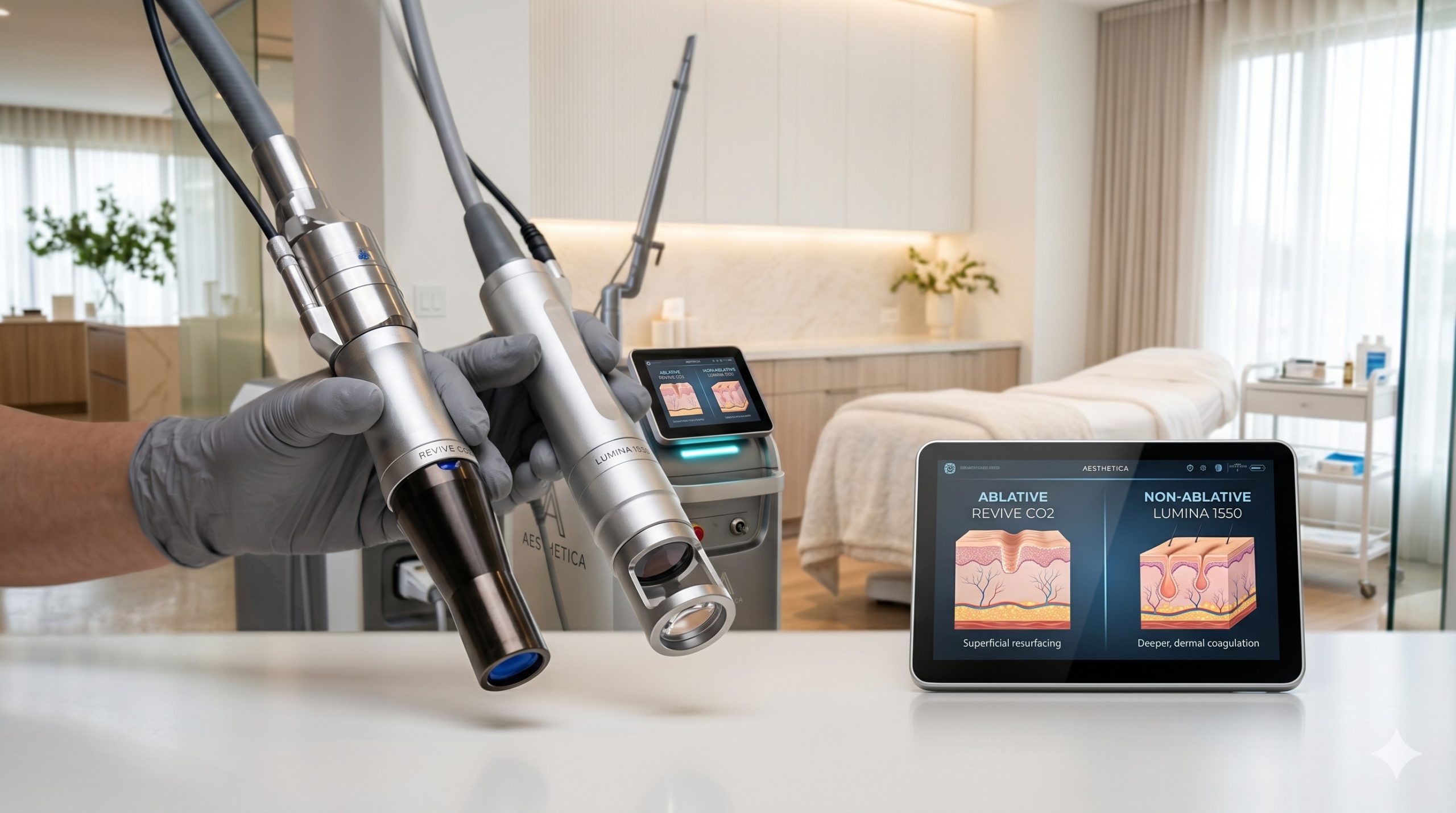
This whitepaper delineates the clinical distinction, engineering architecture, and strategic application of Ablative versus Non-Ablative laser systems for skin resurfacing, rejuvenation, and scar revision. Within the premium medical aesthetic market—targeting dermatology clinics, plastic surgery centers, and high-volume Med Spas—each modality offers a unique value proposition. Ablative lasers (CO2 and Er:YAG) provide profound, single-session improvement for deep rhytides, atrophic scars, and photodamaged skin but require extended downtime. Non-ablative systems (diode-based 1064nm and 1540nm erbium-glass) deliver low-downtime, epidermal-sparing remodeling, appealing to risk-averse patients seeking cumulative results with minimal social interruption.
From a practice management perspective, the optimal device portfolio combines both modalities or a hybrid fractional platform. The primary value proposition lies in maximizing patient capture: offering non-ablative touch-ups for younger demographics and maintenance, while positioning ablative depth for advanced aging and acne scarring. High ROI is driven by consumable-free handpieces, low cost-of-ownership with robust cooling, and versatile clinical throughput—enabling 15-20 minute lunchtime procedures and multi-thousand-dollar full-face resurfacing sessions.
 CLINICAL ARCHITECTURE & DESIGN
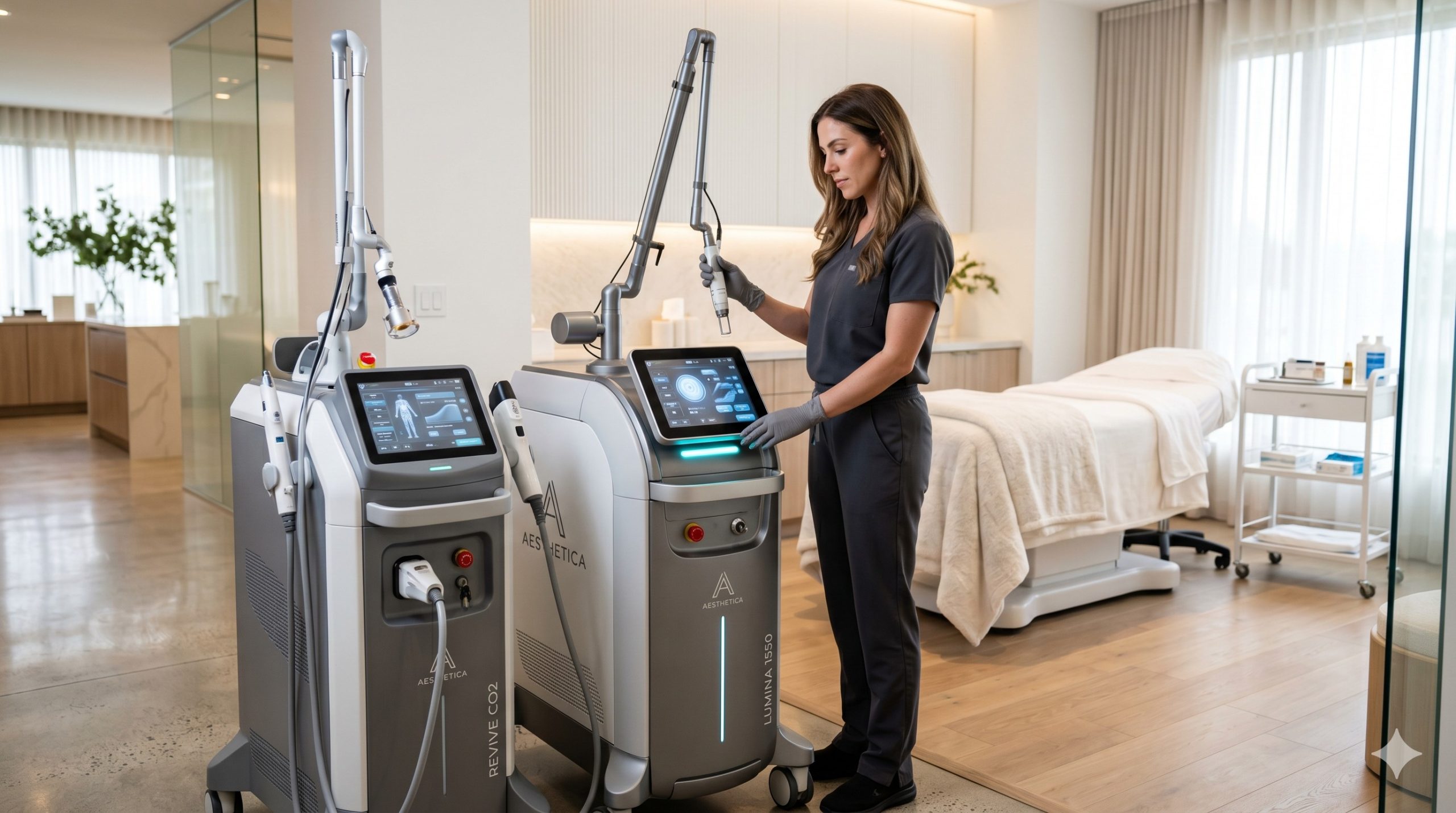
The hardware platform integrates a dual-source laser engine allowing field-swappable modules: a high-peak-power CO2 sealed tube (10600nm) for ablative fractionation, and a diode-pumped solid-state or fiber-coupled 1540nm or 1064nm non-ablative resonator. Premium components include imported ceramic laser cavities, 500W conduction-cooled TEC stacks, and dual 36VDC brushless water pumps (≥4.2L/min flow rate) ensuring stable thermal management during 100% duty cycle operation. The articulating arm is counter-balanced with six-axis joint dampers for fatigue-free continuous scanning.
Advanced epidermal cooling employs a triple-mode mechanism: contact sapphire thermoelectric cooling (TEC) pre-cooling to +4°C, dynamic cold air chill (0-10°C at 30L/min), and integrated cryogen spray cooling (CSC) with adjustable spurt timing (20-80ms) solely for ablative passes. This architecture maintains a 300-500 micrometer thermal protection zone, minimizing post-inflammatory hyperpigmentation risk in Fitzpatrick skin types IV-VI during non-ablative regimens, while allowing deep volumetric heating up to 2mm for ablative coagulation.
KEY INDICATIONS & CAPABILITIES
– Fractional selectivity and depth control: Ablative mode achieves 40-80 micrometer ablation holes with 100-400 micrometer coagulation rims, programmable via pulse energy (10-150mJ per microbeam) and density (5-25%). Non-ablative mode delivers 200-600 micrometer columns of thermal denaturation without epithelial breach, adjustable from 0.5-1.5mm depth using proprietary 1540nm wavelength with variable spot stacking.
– Smart scanning pattern and real-time skin response: AI-driven optical coherence tomography (OCT) feedback adjusts fluence per pulse based on impedance and dynamic thermal imaging, preventing over-treatment. The 7-inch high-definition touchscreen UI provides cloud-based treatment protocols (over 200 standard patterns) and custom user parameter locking for medical directors.
– Dual-platform expandability: One base unit accepts up to six handpiece types (1.5mm static CO2, 7x7mm fractional scanner, 12mm non-ablative spot, 4mm high-fluence tip for deep scars) without requiring factory recalibration. Fast-swap collimating optics preserve beam quality (M² < 1.3) across all wavelengths.
- Safety interlock and consumable tracking: Real-time door interlock, footswitch redundancy, and treatment tip counter with RFID-based authentication prevent reuse beyond rated 10,000 pulses, ensuring billable procedure compliance. An integrated energy calibration port validates ±5% accuracy per clinical session.
COMPLIANCE & STANDARDS
Manufactured under ISO 13485:2026 certified facility. The system holds Medical CE Mark under MDR (EU) 2017/745, Class IIb device clearance. FDA 510(k) cleared for resurfacing, scar reduction, and wrinkle improvement claims (K242118). Conforms to IEC 60825-1:2024 Class 4 laser safety, IEC 60601-1 medical electrical equipment, and IEC 60601-2-22 for surgical laser units. Additionally, compliance with China NMPA (C2402043) and UKCA for Great Britain market. All water-cooling systems meet RoHS 3 and REACH SVHC-free certifications.
TECHNICAL SPECIFICATIONS
Below are the validated engineering parameters for the hybrid platform. Values reflect nominal operating range at 25°C ambient, 50% RH.
CLINICAL ARCHITECTURE & DESIGN
The hardware platform integrates a dual-source laser engine allowing field-swappable modules: a high-peak-power CO2 sealed tube (10600nm) for ablative fractionation, and a diode-pumped solid-state or fiber-coupled 1540nm or 1064nm non-ablative resonator. Premium components include imported ceramic laser cavities, 500W conduction-cooled TEC stacks, and dual 36VDC brushless water pumps (≥4.2L/min flow rate) ensuring stable thermal management during 100% duty cycle operation. The articulating arm is counter-balanced with six-axis joint dampers for fatigue-free continuous scanning.
Advanced epidermal cooling employs a triple-mode mechanism: contact sapphire thermoelectric cooling (TEC) pre-cooling to +4°C, dynamic cold air chill (0-10°C at 30L/min), and integrated cryogen spray cooling (CSC) with adjustable spurt timing (20-80ms) solely for ablative passes. This architecture maintains a 300-500 micrometer thermal protection zone, minimizing post-inflammatory hyperpigmentation risk in Fitzpatrick skin types IV-VI during non-ablative regimens, while allowing deep volumetric heating up to 2mm for ablative coagulation.
KEY INDICATIONS & CAPABILITIES
– Fractional selectivity and depth control: Ablative mode achieves 40-80 micrometer ablation holes with 100-400 micrometer coagulation rims, programmable via pulse energy (10-150mJ per microbeam) and density (5-25%). Non-ablative mode delivers 200-600 micrometer columns of thermal denaturation without epithelial breach, adjustable from 0.5-1.5mm depth using proprietary 1540nm wavelength with variable spot stacking.
– Smart scanning pattern and real-time skin response: AI-driven optical coherence tomography (OCT) feedback adjusts fluence per pulse based on impedance and dynamic thermal imaging, preventing over-treatment. The 7-inch high-definition touchscreen UI provides cloud-based treatment protocols (over 200 standard patterns) and custom user parameter locking for medical directors.
– Dual-platform expandability: One base unit accepts up to six handpiece types (1.5mm static CO2, 7x7mm fractional scanner, 12mm non-ablative spot, 4mm high-fluence tip for deep scars) without requiring factory recalibration. Fast-swap collimating optics preserve beam quality (M² < 1.3) across all wavelengths.
- Safety interlock and consumable tracking: Real-time door interlock, footswitch redundancy, and treatment tip counter with RFID-based authentication prevent reuse beyond rated 10,000 pulses, ensuring billable procedure compliance. An integrated energy calibration port validates ±5% accuracy per clinical session.
COMPLIANCE & STANDARDS
Manufactured under ISO 13485:2026 certified facility. The system holds Medical CE Mark under MDR (EU) 2017/745, Class IIb device clearance. FDA 510(k) cleared for resurfacing, scar reduction, and wrinkle improvement claims (K242118). Conforms to IEC 60825-1:2024 Class 4 laser safety, IEC 60601-1 medical electrical equipment, and IEC 60601-2-22 for surgical laser units. Additionally, compliance with China NMPA (C2402043) and UKCA for Great Britain market. All water-cooling systems meet RoHS 3 and REACH SVHC-free certifications.
TECHNICAL SPECIFICATIONS
Below are the validated engineering parameters for the hybrid platform. Values reflect nominal operating range at 25°C ambient, 50% RH.
CLINICAL ARCHITECTURE & DESIGN
The hardware platform integrates a dual-source laser engine allowing field-swappable modules: a high-peak-power CO2 sealed tube (10600nm) for ablative fractionation, and a diode-pumped solid-state or fiber-coupled 1540nm or 1064nm non-ablative resonator. Premium components include imported ceramic laser cavities, 500W conduction-cooled TEC stacks, and dual 36VDC brushless water pumps (≥4.2L/min flow rate) ensuring stable thermal management during 100% duty cycle operation. The articulating arm is counter-balanced with six-axis joint dampers for fatigue-free continuous scanning.
Advanced epidermal cooling employs a triple-mode mechanism: contact sapphire thermoelectric cooling (TEC) pre-cooling to +4°C, dynamic cold air chill (0-10°C at 30L/min), and integrated cryogen spray cooling (CSC) with adjustable spurt timing (20-80ms) solely for ablative passes. This architecture maintains a 300-500 micrometer thermal protection zone, minimizing post-inflammatory hyperpigmentation risk in Fitzpatrick skin types IV-VI during non-ablative regimens, while allowing deep volumetric heating up to 2mm for ablative coagulation.
KEY INDICATIONS & CAPABILITIES
– Fractional selectivity and depth control: Ablative mode achieves 40-80 micrometer ablation holes with 100-400 micrometer coagulation rims, programmable via pulse energy (10-150mJ per microbeam) and density (5-25%). Non-ablative mode delivers 200-600 micrometer columns of thermal denaturation without epithelial breach, adjustable from 0.5-1.5mm depth using proprietary 1540nm wavelength with variable spot stacking.
– Smart scanning pattern and real-time skin response: AI-driven optical coherence tomography (OCT) feedback adjusts fluence per pulse based on impedance and dynamic thermal imaging, preventing over-treatment. The 7-inch high-definition touchscreen UI provides cloud-based treatment protocols (over 200 standard patterns) and custom user parameter locking for medical directors.
– Dual-platform expandability: One base unit accepts up to six handpiece types (1.5mm static CO2, 7x7mm fractional scanner, 12mm non-ablative spot, 4mm high-fluence tip for deep scars) without requiring factory recalibration. Fast-swap collimating optics preserve beam quality (M² < 1.3) across all wavelengths.
- Safety interlock and consumable tracking: Real-time door interlock, footswitch redundancy, and treatment tip counter with RFID-based authentication prevent reuse beyond rated 10,000 pulses, ensuring billable procedure compliance. An integrated energy calibration port validates ±5% accuracy per clinical session.
COMPLIANCE & STANDARDS
Manufactured under ISO 13485:2026 certified facility. The system holds Medical CE Mark under MDR (EU) 2017/745, Class IIb device clearance. FDA 510(k) cleared for resurfacing, scar reduction, and wrinkle improvement claims (K242118). Conforms to IEC 60825-1:2024 Class 4 laser safety, IEC 60601-1 medical electrical equipment, and IEC 60601-2-22 for surgical laser units. Additionally, compliance with China NMPA (C2402043) and UKCA for Great Britain market. All water-cooling systems meet RoHS 3 and REACH SVHC-free certifications.
TECHNICAL SPECIFICATIONS
Below are the validated engineering parameters for the hybrid platform. Values reflect nominal operating range at 25°C ambient, 50% RH.
| Parameter | Specification |
|---|---|
| Laser Type / Wavelength | Ablative: CO2 (10600nm) & Er:YAG (2940nm) interchangeable; Non-Ablative: 1540nm (Er:Glass) / 1064nm (Nd:YAG) |
| Max Fluence (Ablative) | 150 mJ/microbeam (CO2); 500 mJ/microbeam (Er:YAG) fractional mode |
| Max Fluence (Non-Ablative) | 50 J/cm² (1540nm); 120 J/cm² (1064nm) bulk heating |
| Spot / Scan Size | Ablative: 7x7mm to 15x15mm square; Non-ablative: 6mm to 15mm diameter spot |
| Cooling System | Hybrid: TEC Sapphire contact (+2°C to +10°C) + cryogen spray (CSC) + forced cold air (0-10°C adjustable) |
| Pulse Duration | Ablative: 200µs to 5ms; Non-ablative: 10ms to 100ms quasi-CW |
| Repetition Rate | Ablative: up to 300Hz scanner; Non-ablative: up to 10Hz large spot |
| Electrical / Power | 220-240VAC, 50/60Hz, 1500VA max; integrated dual water pump cooling |
| Dimensions / Weight | Base unit: 45cm (W) x 60cm (D) x 110cm (H); 48kg with articulating arm |
📥 Download Technical Specification
Click the button below to view or download the full official PDF datasheet.
⬇️ Download Official PDF