Best Moisturizer for Sensitive Skin: What to Look For
Finding the best moisturizer for sensitive skin can be challenging. Some products that promise deep hydration may cause redness, itching, burning, or uncomfortable stinging. Others may feel too heavy, leave a greasy finish, or fail to provide enough moisture throughout the day.
The right moisturizer should do more than make your skin feel soft. It should help maintain the skin barrier, reduce moisture loss, and provide comfortable hydration without exposing your skin to unnecessary irritants.
Whether you have dry, oily, combination, or easily irritated skin, understanding moisturizer ingredients and formulations can help you make a better choice. This guide explains what to look for in a moisturizer for sensitive skin, which ingredients may be beneficial, and how to select a product that suits your individual needs.
Quick Answer: What Is the Best Moisturizer for Sensitive Skin?
The best moisturizer for sensitive skin is generally a fragrance-free, gentle formulation that provides adequate hydration and supports the skin barrier without causing irritation.
When choosing a moisturizer, look for ingredients such as:
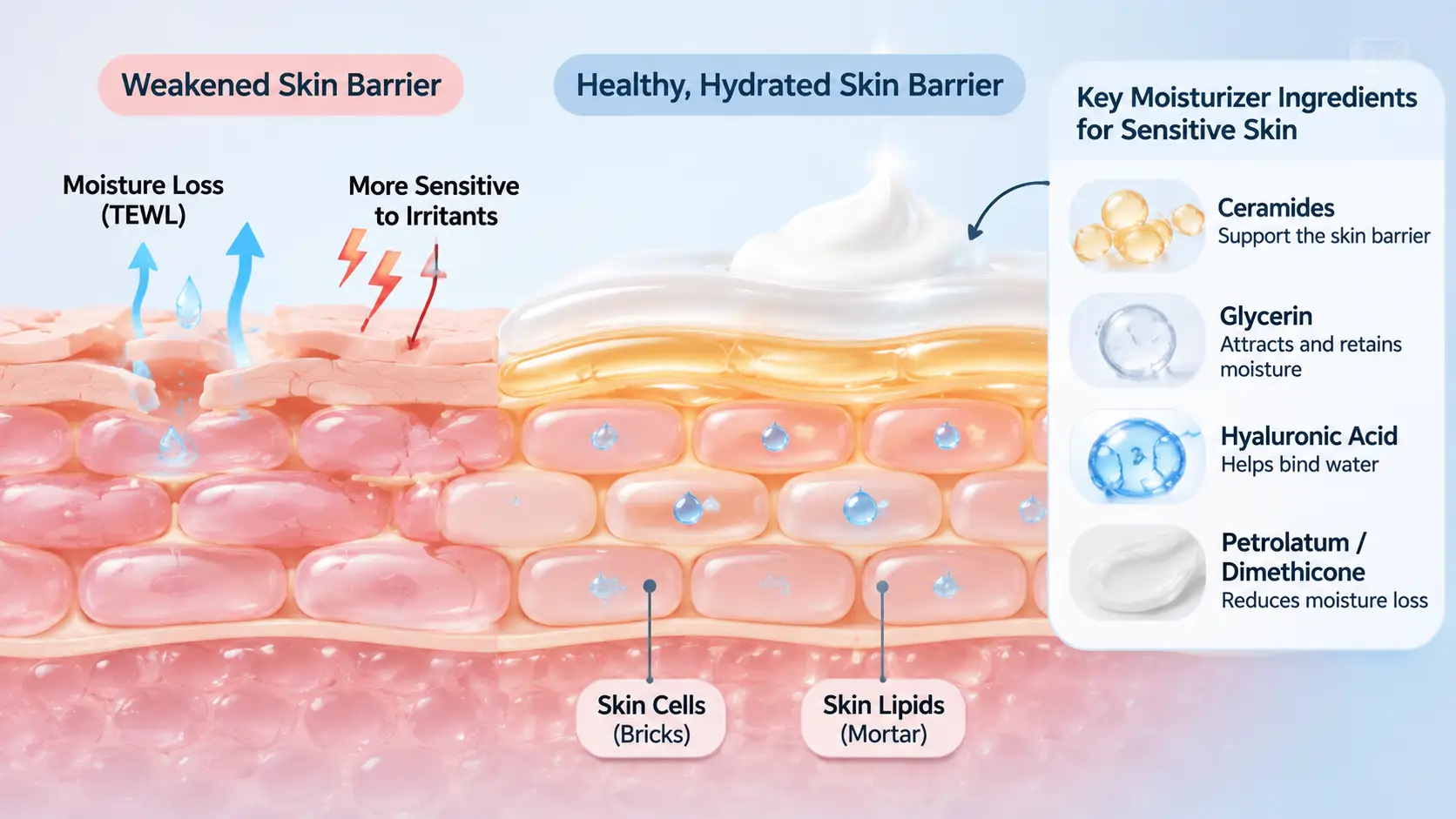
- Ceramides: Help support the skin barrier and maintain its protective lipid structure.
- Glycerin: Attracts water and helps keep the skin hydrated.
- Hyaluronic Acid: Helps bind water within the outer layers of the skin.
- Petrolatum: Forms a protective layer that reduces moisture loss.
- Dimethicone: Helps soften and protect the skin while reducing water loss.
For dry sensitive skin, a richer cream or ointment may provide more effective moisture retention than a lightweight lotion. For oily or combination sensitive skin, a lighter lotion or gel-cream may feel more comfortable.
There is no single moisturizer that works best for everyone. Skin type, existing skin conditions, ingredient sensitivities, and personal tolerance all influence product selection.
1. Why Does Sensitive Skin Need a Suitable Moisturizer?
Sensitive skin can react more easily to environmental conditions, skincare ingredients, and everyday irritants. People may experience redness, dryness, itching, tightness, burning, or stinging after using certain products.
One possible contributing factor is a weakened or disrupted skin barrier.
Understanding the Skin Barrier
The outermost layer of the skin, known as the stratum corneum, plays an essential role in protecting the body. It consists primarily of flattened skin cells surrounded by a mixture of lipids, including ceramides, cholesterol, and fatty acids.
This structure is often compared to a brick wall. Skin cells act like bricks, while the surrounding lipids function as the mortar holding everything together.
When the skin barrier is functioning properly, it helps:
- Reduce excessive water loss from the skin.
- Protect against external irritants and environmental exposure.
- Maintain comfortable skin hydration.
- Support the skin’s natural protective function.
When the barrier becomes disrupted, the skin may lose moisture more easily and become more vulnerable to irritation.
How Moisturizers Support the Skin Barrier
Moisturizers contain different types of ingredients that work together to improve skin hydration and reduce moisture loss.
Most moisturizing formulations combine three important ingredient categories:
- Humectants: Attract water and help increase hydration in the outer skin layers.
- Emollients: Soften and smooth the skin by filling spaces between surface skin cells.
- Occlusives: Form a protective layer that helps reduce water evaporation from the skin.
A well-formulated moisturizer may combine ingredients from all three categories to provide more complete hydration.
For sensitive skin, the objective is not necessarily to choose the product with the highest number of moisturizing ingredients. Instead, look for a formulation that provides sufficient hydration without triggering unwanted reactions.
2. Best Ingredients to Look for in a Moisturizer for Sensitive Skin
Understanding the ingredients in a moisturizer is one of the most useful ways to identify products that may suit sensitive skin.
Rather than focusing only on marketing claims such as soothing, calming, or hypoallergenic, examine the ingredient list and consider what each ingredient does.
1. Ceramides: Supporting the Skin Barrier
Ceramides are naturally occurring lipids found in the outermost layer of the skin. They play an important role in maintaining the skin’s protective barrier and limiting excessive water loss.
Moisturizers containing ceramides are commonly formulated for dry, sensitive, and barrier-impaired skin.
Potential benefits include:
- Supporting the skin’s natural lipid barrier.
- Helping maintain skin hydration.
- Reducing moisture loss when used in an appropriate formulation.
- Improving the feel of dry and rough skin.
If your skin frequently feels tight or dry after cleansing, a moisturizer containing ceramides may be worth considering.
2. Glycerin: A Reliable Hydrating Ingredient
Glycerin is a humectant widely used in moisturizing skincare products. It attracts and retains water, helping improve hydration in the outer layers of the skin.
It is found in many types of products, including facial creams, body lotions, hydrating serums, and gentle cleansers.
Glycerin is particularly useful because it can be incorporated into lightweight as well as rich moisturizing formulations.
For people with sensitive skin, a fragrance-free moisturizer containing glycerin can be a practical starting point when looking for everyday hydration.
3. Hyaluronic Acid: Helping Maintain Skin Hydration
Hyaluronic acid is a water-binding ingredient naturally present in the skin and widely used in skincare formulations.
It helps attract and hold water, making it a popular ingredient in hydrating serums, lotions, and facial moisturizers.
Potential benefits include:
- Supporting hydration in the outer skin layers.
- Helping skin feel softer and smoother.
- Providing hydration without necessarily creating a heavy or greasy finish.
Hyaluronic acid is generally well tolerated, although the complete formulation matters. If a product containing it causes irritation, another ingredient in the formula may be responsible.
4. Petrolatum: Reducing Moisture Loss
Petrolatum is an occlusive ingredient that creates a protective layer on the skin’s surface. This layer helps reduce transepidermal water loss, allowing the skin to retain moisture.
It is particularly useful for very dry skin, rough patches, and areas that need additional protection.
However, petrolatum-based products can feel thick or greasy. People with oily skin may prefer using them only on particularly dry areas rather than applying a heavy layer across the entire face.
5. Dimethicone: Softening and Protecting the Skin
Dimethicone is a silicone-based ingredient frequently used in moisturizers and protective skincare formulations.
It forms a lightweight, smooth film on the skin’s surface and helps reduce moisture loss. It also improves the texture and spreadability of skincare products.
Dimethicone can be useful for people who want a moisturizer that feels smooth without the heavy texture of some ointments.
6. Colloidal Oatmeal: Soothing Dry and Irritated Skin
Colloidal oatmeal is finely ground oat material used in skincare products designed for dry, itchy, and irritation-prone skin.
It contains naturally occurring components that can help soothe the skin and support its protective function.
It is commonly found in moisturizers and products formulated for people with eczema-prone or particularly dry skin.
However, people with known oat allergies or sensitivities should review product ingredients carefully before use.
7. Panthenol: Supporting Skin Hydration
Panthenol, also known as provitamin B5, is a moisturizing ingredient used in many facial creams, lotions, and barrier-supporting products.
It acts as a humectant and skin-conditioning ingredient, helping improve skin hydration and softness.
Panthenol may be useful in moisturizers designed for dry or uncomfortable skin, although individual tolerance still matters.
Comparison of Common Moisturizing Ingredients
| Ingredient | Category | Main Function | Suitable Formulations |
|---|---|---|---|
| Ceramides | Barrier-supporting lipids | Support the skin barrier | Creams and lotions |
| Glycerin | Humectant | Attracts and retains water | Serums, lotions, and creams |
| Hyaluronic Acid | Humectant | Helps bind water | Serums and moisturizers |
| Petrolatum | Occlusive | Reduces moisture loss | Ointments and protective balms |
| Dimethicone | Emollient and protective agent | Softens and protects the skin | Lotions and creams |
| Colloidal Oatmeal | Skin-conditioning ingredient | Helps soothe dry, irritated skin | Soothing creams |
| Panthenol | Humectant and conditioning agent | Supports hydration and softness | Serums, creams, and lotions |
These ingredients can be useful when selecting a moisturizer for sensitive skin, but no ingredient guarantees that a finished product will be suitable for everyone. The overall formulation and your individual skin tolerance remain important.
3. Ingredients to Avoid in Moisturizers for Sensitive Skin
Choosing a moisturizer for sensitive skin involves more than looking for beneficial ingredients. It is equally important to understand which ingredients may cause irritation or trigger allergic reactions.
Not everyone reacts to the same ingredients. However, certain fragrances, preservatives, and active skincare ingredients deserve additional attention when selecting a facial moisturizer.
Fragrance and Perfume
Fragrance is one of the ingredients worth checking carefully when shopping for a moisturizer for sensitive skin.
Both synthetic fragrances and naturally derived aromatic ingredients can cause irritation or allergic contact dermatitis in susceptible individuals.
Consider choosing products labeled fragrance-free rather than relying only on terms such as natural, botanical, or unscented.
Essential Oils
Essential oils are frequently included in skincare products to provide fragrance or botanical properties. However, ingredients such as lavender oil, peppermint oil, citrus oils, and tea tree oil may irritate some sensitive skin types.
Natural ingredients are not automatically gentler than synthetic alternatives. If your skin frequently reacts to fragranced products, fragrance-free formulations may be a more practical choice.
Alcohol in Skincare Products
Some alcohol-containing formulations may contribute to dryness or irritation, particularly when used frequently on already compromised skin.
However, not all alcohols have the same function. Fatty alcohols such as cetyl alcohol, cetearyl alcohol, and stearyl alcohol are commonly used as emollients and texture-enhancing ingredients in moisturizers.
Therefore, it is important to distinguish between different types of alcohol rather than avoiding every ingredient with the word alcohol in its name.
Strong Exfoliating Ingredients
Some moisturizers contain additional active ingredients, including alpha hydroxy acids (AHAs), beta hydroxy acids (BHAs), and other exfoliating compounds.
Although these ingredients can be useful for specific skincare concerns, they may cause stinging, dryness, or peeling in people with sensitive or irritated skin.
If your skin is currently red, uncomfortable, or peeling, consider using a simpler moisturizer without exfoliating ingredients until the irritation has settled.
High-Strength Retinoids
Retinoids are commonly used to address acne, uneven skin texture, and visible signs of aging. However, they can also cause dryness, redness, peeling, and irritation, particularly when first introduced.
People with sensitive skin should be cautious when selecting products that combine moisturizing ingredients with strong retinoid formulations. A basic moisturizer may be a better starting point before introducing additional active treatments.
Potentially Irritating Preservatives
Preservatives are necessary in many water-based skincare products because they help prevent microbial contamination and maintain product safety.
However, certain preservatives can cause allergic contact dermatitis in susceptible individuals. People with a known preservative allergy should check ingredient lists and follow advice from their dermatologist.
It is not advisable to choose an inadequately preserved moisturizer simply to avoid preservatives. Product safety and stability are important considerations.
Ingredients and Formulations Worth Reviewing
| Ingredient or Category | Potential Concern | What to Consider |
|---|---|---|
| Fragrance and perfume | May trigger irritation or allergic reactions | Prefer fragrance-free formulations |
| Essential oils | May cause irritation or contact allergy | Use caution with fragranced botanical products |
| Some drying alcohols | May contribute to dryness and discomfort | Evaluate the specific alcohol and formulation |
| Strong exfoliating acids | May increase stinging and peeling | Avoid during periods of active irritation |
| High-strength retinoids | May cause dryness and redness | Introduce cautiously when appropriate |
| Individual allergenic preservatives | May trigger allergic contact dermatitis | Check known allergens and seek professional advice |
Remember that sensitive skin does not require avoiding every active ingredient. The most important consideration is whether a particular formulation is suitable for your skin and whether you can use it comfortably.
4. Best Moisturizer for Different Sensitive Skin Types
Not all sensitive skin is the same. Some people experience persistent dryness and tightness, while others have oily skin that becomes irritated easily.
Choosing the best moisturizer for sensitive skin therefore requires considering both skin sensitivity and your underlying skin type.
Best Moisturizer for Dry Sensitive Skin
Dry sensitive skin often needs a richer moisturizer that provides hydration and helps reduce water loss.
When choosing a moisturizer for dry sensitive skin, consider formulations containing:
- Ceramides: Help support the skin’s natural protective barrier.
- Glycerin: Attracts water and supports hydration.
- Petrolatum: Helps reduce moisture loss.
- Shea Butter: Provides emollient properties that soften dry skin.
- Dimethicone: Helps smooth and protect the skin surface.
Creams and ointments are often more suitable than lightweight gels when the skin is particularly dry.
If your face feels tight after washing or becomes flaky throughout the day, a richer fragrance-free moisturizer may be worth considering.
Best Moisturizer for Oily Sensitive Skin
Oily skin can still be sensitive. Excess sebum production does not necessarily mean that the skin has sufficient hydration or a healthy protective barrier.
People with oily sensitive skin may prefer lightweight formulations that provide moisture without leaving an excessively greasy finish.
Look for:
- Lightweight lotions or gel-creams.
- Fragrance-free formulations.
- Glycerin and hyaluronic acid for hydration.
- Dimethicone for a smooth skin feel.
- Products labeled non-comedogenic when pore congestion is a concern.
Avoid assuming that oily skin should not use moisturizer. An appropriate moisturizing product can help maintain skin comfort without necessarily making the skin feel heavier.
Best Moisturizer for Combination Sensitive Skin
Combination skin typically has different hydration needs across the face. The forehead, nose, and chin may produce more oil, while the cheeks feel dry or tight.
A lightweight, balanced moisturizer is often a practical starting point.
You can also adjust the amount of moisturizer applied to different facial areas. For example, use a slightly richer layer on dry cheeks and a thinner layer on oilier areas.
Look for a formulation containing glycerin, ceramides, or other well-tolerated moisturizing ingredients.
Best Moisturizer for Acne-Prone Sensitive Skin
Acne-prone sensitive skin requires a careful balance between hydration and product tolerability.
Some acne treatments, including benzoyl peroxide and topical retinoids, can cause dryness, peeling, and irritation. A suitable moisturizer may help improve comfort while using these treatments.
Consider:
- Lightweight, fragrance-free moisturizers.
- Non-comedogenic formulations if you are prone to clogged pores.
- Glycerin and ceramides for hydration and barrier support.
- Simple formulations without unnecessary exfoliating ingredients.
Non-comedogenic labeling can be useful, but it does not guarantee that a product will never cause breakouts or irritation.
If you have persistent acne alongside significant skin sensitivity, a dermatologist can help you select compatible skincare products and treatments.
Best Moisturizer for Eczema-Prone Sensitive Skin
People with eczema-prone skin often experience dryness, itching, and an impaired skin barrier. They may benefit from thicker, fragrance-free creams or ointments designed to reduce moisture loss.
Commonly used moisturizing ingredients include petrolatum, glycerin, and ceramides.
Apply moisturizer regularly, especially after bathing or washing, while the skin is still slightly damp.
However, moisturizer alone may not adequately control an eczema flare. Persistent inflammation, severe itching, or recurring rashes may require medical treatment prescribed by a healthcare professional.
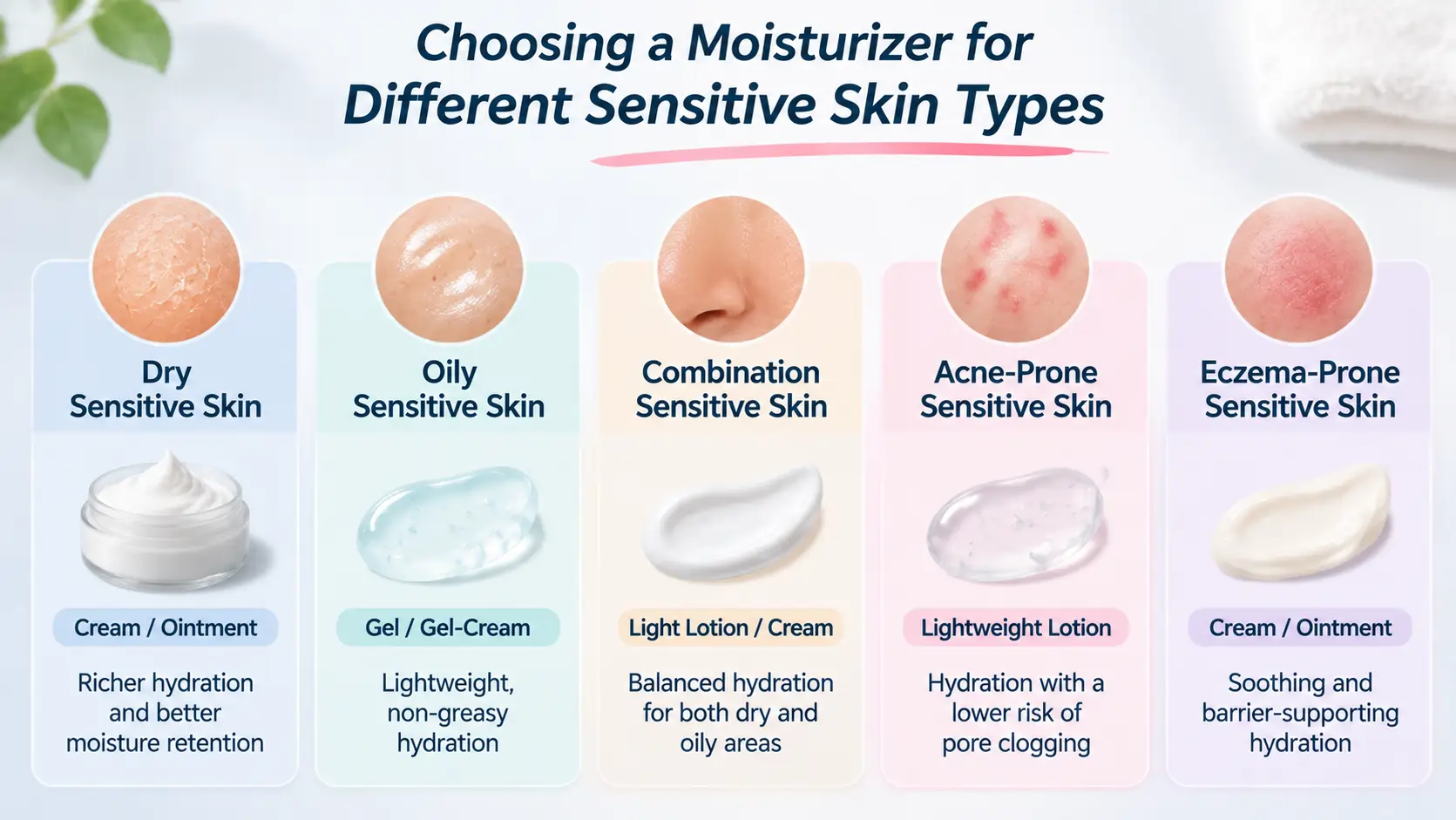
Moisturizer Selection by Skin Type
| Skin Type | Recommended Texture | Ingredients to Consider |
|---|---|---|
| Dry sensitive skin | Rich cream or ointment | Ceramides, glycerin, petrolatum |
| Oily sensitive skin | Light lotion or gel-cream | Glycerin, hyaluronic acid, dimethicone |
| Combination sensitive skin | Lightweight cream or lotion | Ceramides, glycerin |
| Acne-prone sensitive skin | Lightweight, non-comedogenic formulation | Glycerin, ceramides, dimethicone |
| Eczema-prone sensitive skin | Rich cream or ointment | Petrolatum, ceramides, glycerin |
These are general selection guidelines rather than universal rules. Your skin’s response to a particular formulation is more important than its marketing category.
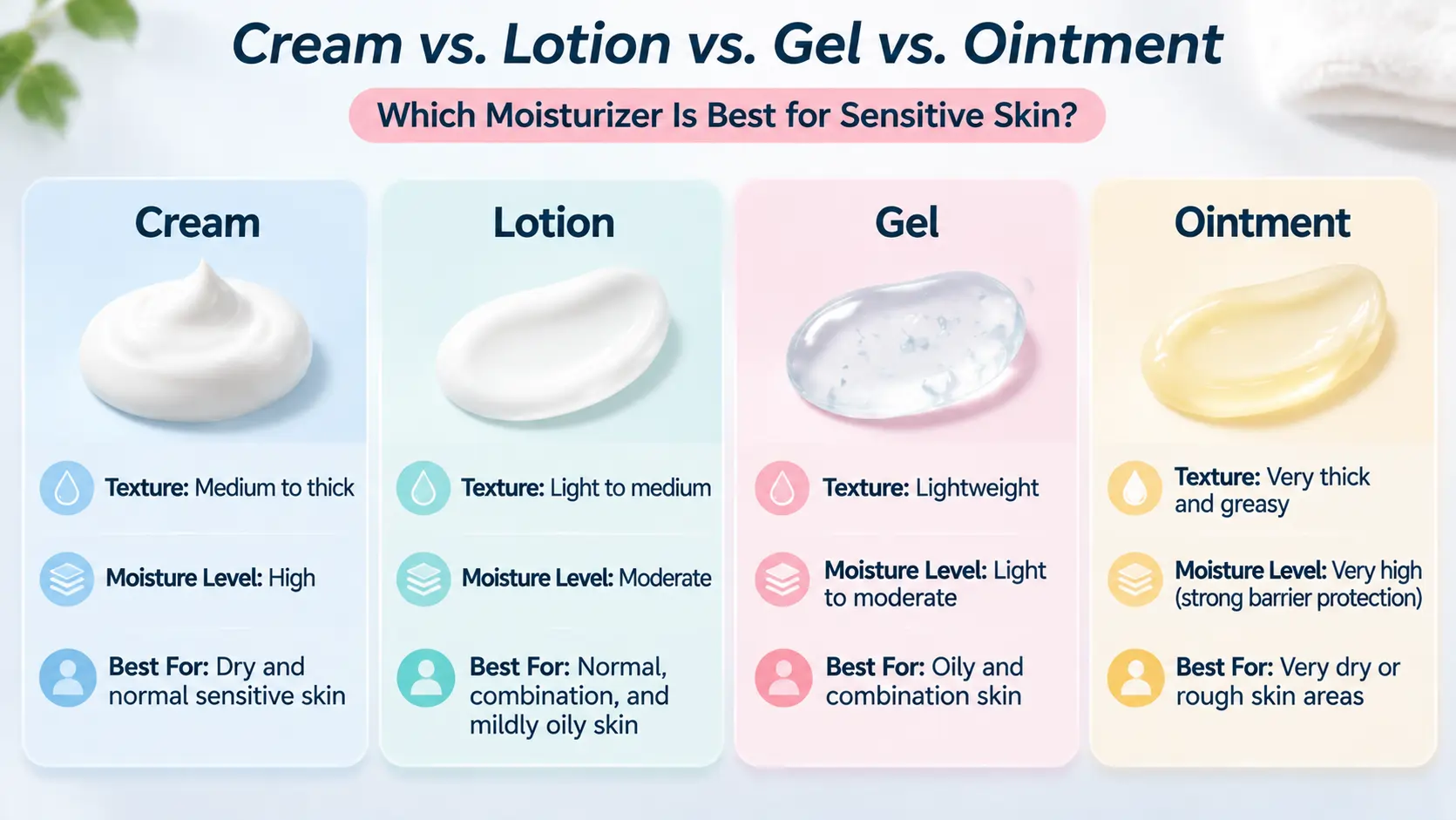
5. Cream vs. Lotion vs. Gel: Which Moisturizer Is Best for Sensitive Skin?
Moisturizers are available in several textures, including creams, lotions, gels, and ointments. These formulations differ in their consistency, oil-to-water balance, and ability to reduce moisture loss.
Understanding these differences can help you choose a moisturizer that feels comfortable and provides the level of hydration your skin needs.
Cream Moisturizers
Creams generally have a thicker consistency than lotions and contain a combination of water, oils, emollients, and other moisturizing ingredients.
They are often suitable for dry or dehydrated sensitive skin because they can provide both hydration and skin-softening benefits.
Advantages include:
- Generally provide richer moisturization than lightweight lotions.
- Can contain barrier-supporting ingredients such as ceramides.
- May help improve the feel of rough or dry skin.
However, some creams may feel too heavy for people with oily skin or those who dislike richer textures.
Lotion Moisturizers
Lotions are generally lighter than creams and spread easily across the skin. They typically contain a higher proportion of water relative to oils than richer creams.
A lightweight lotion may be a suitable option for people with normal, combination, or mildly oily sensitive skin.
Advantages include:
- Lightweight and easy to spread.
- Convenient for everyday facial and body use.
- Often comfortable in warm or humid environments.
Some lotions may not provide sufficient moisture for very dry or barrier-impaired skin.
Gel Moisturizers
Gel moisturizers usually have a lightweight, water-based texture. They often contain humectants such as glycerin or hyaluronic acid.
They can be appealing to people who prefer a non-heavy skincare product, particularly those with oily or combination skin.
However, not every gel moisturizer provides enough occlusive protection for dry sensitive skin. Some formulas may also contain fragrance or other ingredients that certain individuals do not tolerate.
Ointment Moisturizers
Ointments generally contain a high proportion of oils or occlusive ingredients, such as petrolatum, and provide strong protection against moisture loss.
They can be particularly useful for very dry skin, rough patches, and areas that need additional protection.
Their thicker and greasier texture may make them less appealing for everyday use across the entire face, especially for people with oily skin.
Moisturizer Texture Comparison
| Formulation | Texture | Typical Use | Potential Limitation |
|---|---|---|---|
| Cream | Medium to thick | Dry and normal sensitive skin | May feel heavy on oily skin |
| Lotion | Light to medium | Normal, combination, and mildly oily skin | May be insufficient for very dry skin |
| Gel | Lightweight | Oily and combination skin | May provide limited moisture-loss protection |
| Ointment | Very thick and greasy | Very dry or rough skin areas | May feel uncomfortable for full-face application |
There is no universally best moisturizer texture for sensitive skin. Choose a formulation that provides adequate hydration, suits your skin type, and does not cause discomfort.
6. How to Choose the Best Face Moisturizer for Sensitive Skin
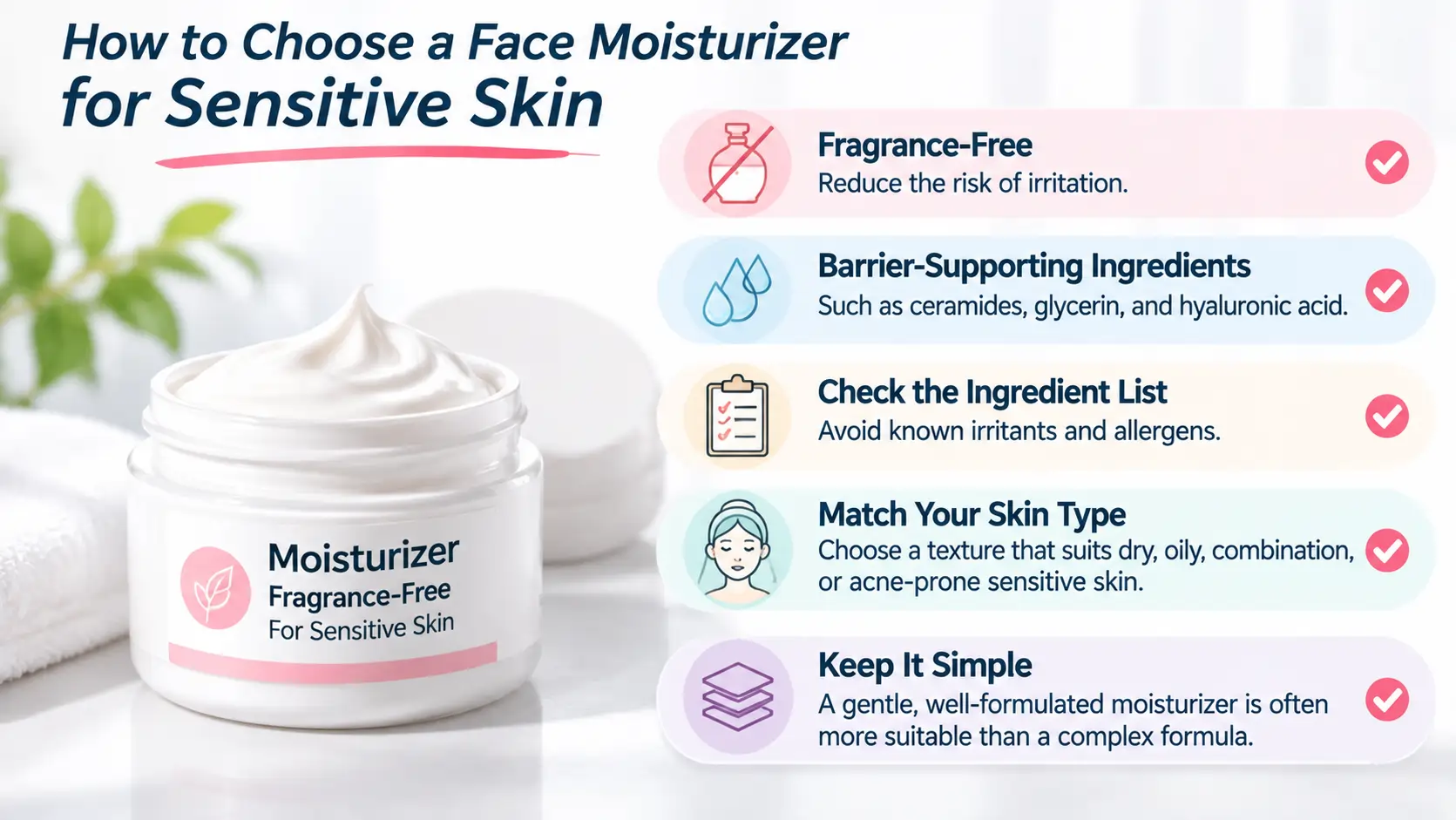
Finding the best face moisturizer for sensitive skin requires more than selecting a product labeled for sensitive skin. You should consider its ingredients, formulation, skin compatibility, and ability to maintain hydration without causing irritation.
Before purchasing a new moisturizer, consider the following factors.
Choose Fragrance-Free Products
Fragrance is a common cause of allergic contact dermatitis. If your skin frequently becomes red, itchy, or uncomfortable after using skincare products, choosing a fragrance-free moisturizer is a sensible first step.
Pay attention to the distinction between fragrance-free and unscented. Unscented products may contain ingredients designed to mask other odors, whereas fragrance-free products are formulated without added fragrance.
Look for Skin Barrier-Supporting Ingredients
A suitable moisturizer should help maintain hydration and support the skin’s natural protective barrier.
Some ingredients worth considering include:
- Ceramides: Lipids naturally found in the skin barrier that help maintain its structure.
- Glycerin: A humectant that attracts water and helps maintain skin hydration.
- Hyaluronic Acid: A humectant that helps bind water within the outer layers of the skin.
- Petrolatum: An occlusive ingredient that helps reduce transepidermal water loss.
- Dimethicone: A skin-conditioning ingredient that helps smooth the skin and reduce moisture loss.
These ingredients serve different functions. A well-formulated moisturizer may combine humectants, emollients, and occlusive ingredients to provide balanced hydration and protection.
Check the Complete Ingredient List
Do not rely entirely on front-label claims such as gentle, natural, hypoallergenic, or dermatologist-tested.
These terms do not guarantee that a product will be suitable for every sensitive skin type.
Instead, review the ingredient list and pay attention to substances that have previously caused irritation or allergic reactions for you.
Consider Your Skin Type and Climate
Your environment can influence which moisturizer feels most comfortable.
For example, a lightweight lotion or gel-cream may be more comfortable in hot and humid conditions, while a richer cream may be preferable during cold or dry weather.
People with dry sensitive skin may benefit from a thicker formulation, whereas those with oily sensitive skin may prefer a lighter texture.
Look for Non-Comedogenic Formulations When Necessary
If you have sensitive skin that is also prone to acne, consider moisturizers labeled non-comedogenic.
These products are formulated with the intention of reducing pore blockage. However, non-comedogenic labeling does not guarantee that a product will be suitable for every individual.
Prioritize Simplicity Over Too Many Active Ingredients
A moisturizer does not need a long list of active ingredients to be effective.
For sensitive skin, a straightforward formulation containing a few well-tolerated moisturizing ingredients may be easier to incorporate into a daily routine than a product containing multiple exfoliating agents, fragrances, and strong active ingredients.
If your skin is already irritated, consider simplifying your skincare routine before introducing additional treatments.
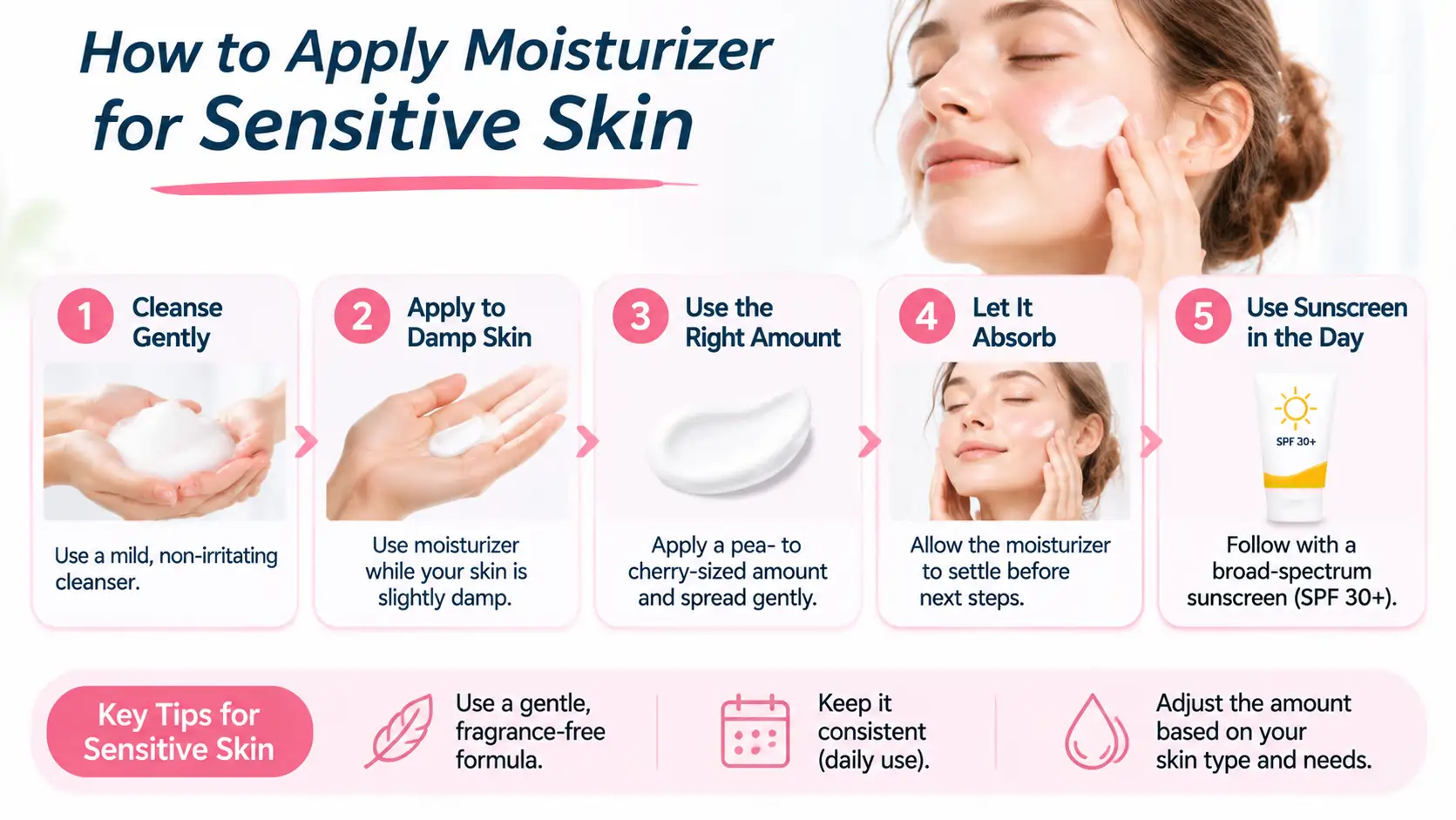
7. How to Apply Moisturizer for Sensitive Skin Correctly
Even a suitable moisturizer may not provide the best experience if it is applied incorrectly or used inconsistently.
Following a simple application routine can help maintain hydration and support the skin barrier.
Step 1: Cleanse Your Skin Gently
Start with a mild cleanser that does not leave your skin feeling tight or excessively dry.
Avoid aggressive scrubbing, harsh cleansing brushes, and excessively hot water, especially when your skin is already irritated.
Step 2: Apply Moisturizer While Skin Is Slightly Damp
After cleansing, gently pat your face with a clean towel without rubbing it completely dry.
Apply moisturizer while your skin is still slightly damp. This can help retain water within the outer layers of the skin.
Step 3: Use an Appropriate Amount
Apply enough moisturizer to cover the skin comfortably without leaving an excessively heavy layer.
Spread the product gently across your face and neck, paying particular attention to areas that tend to become dry.
Avoid vigorous rubbing, especially if your skin is sensitive or inflamed.
Step 4: Allow the Product to Absorb
Give your moisturizer a little time to settle before applying additional skincare products or makeup.
If you are using other prescribed topical treatments, follow your healthcare professional’s instructions regarding product order and application frequency.
Step 5: Apply Sunscreen During the Day
Daily sun protection is an important part of maintaining healthy skin.
After applying your morning moisturizer, use a broad-spectrum sunscreen with SPF 30 or higher. If you have sensitive skin, look for a sunscreen formulation that you tolerate well.
Reapply sunscreen according to its instructions, particularly after swimming, sweating, or prolonged outdoor exposure.
8. Should You Moisturize Sensitive Skin in the Morning and at Night?
For many people with sensitive skin, moisturizing twice daily is a practical starting point. However, the ideal frequency depends on your skin type, environment, and individual skincare needs.
Morning Moisturizing Routine
Morning moisturizing helps maintain hydration throughout the day and prepares the skin for sunscreen and makeup.
A simple morning routine may include:
- Cleanse with a gentle cleanser or rinse with lukewarm water.
- Apply a lightweight or suitable facial moisturizer.
- Allow the moisturizer to settle.
- Finish with broad-spectrum SPF 30 or higher sunscreen.
If your skin is naturally dry, you may prefer a richer moisturizer. People with oily sensitive skin may find a lightweight lotion more comfortable.
Nighttime Moisturizing Routine
Nighttime is another opportunity to maintain skin hydration and reduce dryness.
During the evening, remove sunscreen and makeup with a gentle cleansing routine. Follow with a moisturizer suited to your skin type.
If your skin becomes particularly dry overnight, a richer cream may provide more comfortable moisture retention.
However, you do not necessarily need separate morning and nighttime moisturizers. One well-tolerated product may be sufficient for both routines.
How Often Should You Apply Moisturizer?
Many people benefit from applying moisturizer at least once or twice daily, particularly after washing their face or bathing.
If your skin feels dry or tight throughout the day, additional application may be appropriate.
The goal is to maintain comfortable, hydrated skin rather than following a rigid application schedule.
9. Common Moisturizing Mistakes That Can Irritate Sensitive Skin
Choosing an appropriate moisturizer is important, but certain skincare habits can undermine your efforts to maintain a healthy skin barrier.
Here are some common mistakes to avoid.
Using Too Many Skincare Products at Once
Layering multiple serums, exfoliants, and active treatments can make it difficult to identify which product is causing irritation.
If your skin is frequently uncomfortable, simplify your routine and introduce new products one at a time.
Changing Moisturizers Too Frequently
Constantly switching between different skincare products makes it difficult to determine which formulations your skin tolerates.
Once you find a moisturizer that works comfortably, consider maintaining a consistent routine rather than frequently experimenting with new products.
Over-Exfoliating Sensitive Skin
Frequent exfoliation with scrubs, AHAs, BHAs, or other exfoliating treatments may contribute to irritation, particularly when the skin barrier is already compromised.
Reduce or temporarily discontinue irritating exfoliating products when your skin becomes red, tight, or uncomfortable.
Choosing Products Based Only on Marketing Claims
Words such as natural, organic, gentle, and hypoallergenic do not automatically mean a product is suitable for sensitive skin.
Always consider the actual formulation and your personal history of ingredient reactions.
Applying Moisturizer to Completely Dry Skin
Applying moisturizer while the skin is slightly damp can help retain hydration after cleansing or bathing.
Although applying moisturizer to dry skin is not necessarily harmful, using it shortly after washing is a practical way to reduce moisture loss.
Ignoring Persistent Irritation
Redness, burning, itching, and peeling should not automatically be considered normal reactions to skincare products.
If a moisturizer consistently causes discomfort, stop using it and consider whether an ingredient may be responsible.
Persistent or worsening symptoms should be evaluated by a qualified healthcare professional.
10. How to Test a New Moisturizer Before Using It on Your Face
Introducing a new skincare product gradually is particularly important if you have a history of sensitive skin or allergic reactions.
Even products marketed for sensitive skin can contain ingredients that do not agree with your individual skin.
Perform a Patch Test
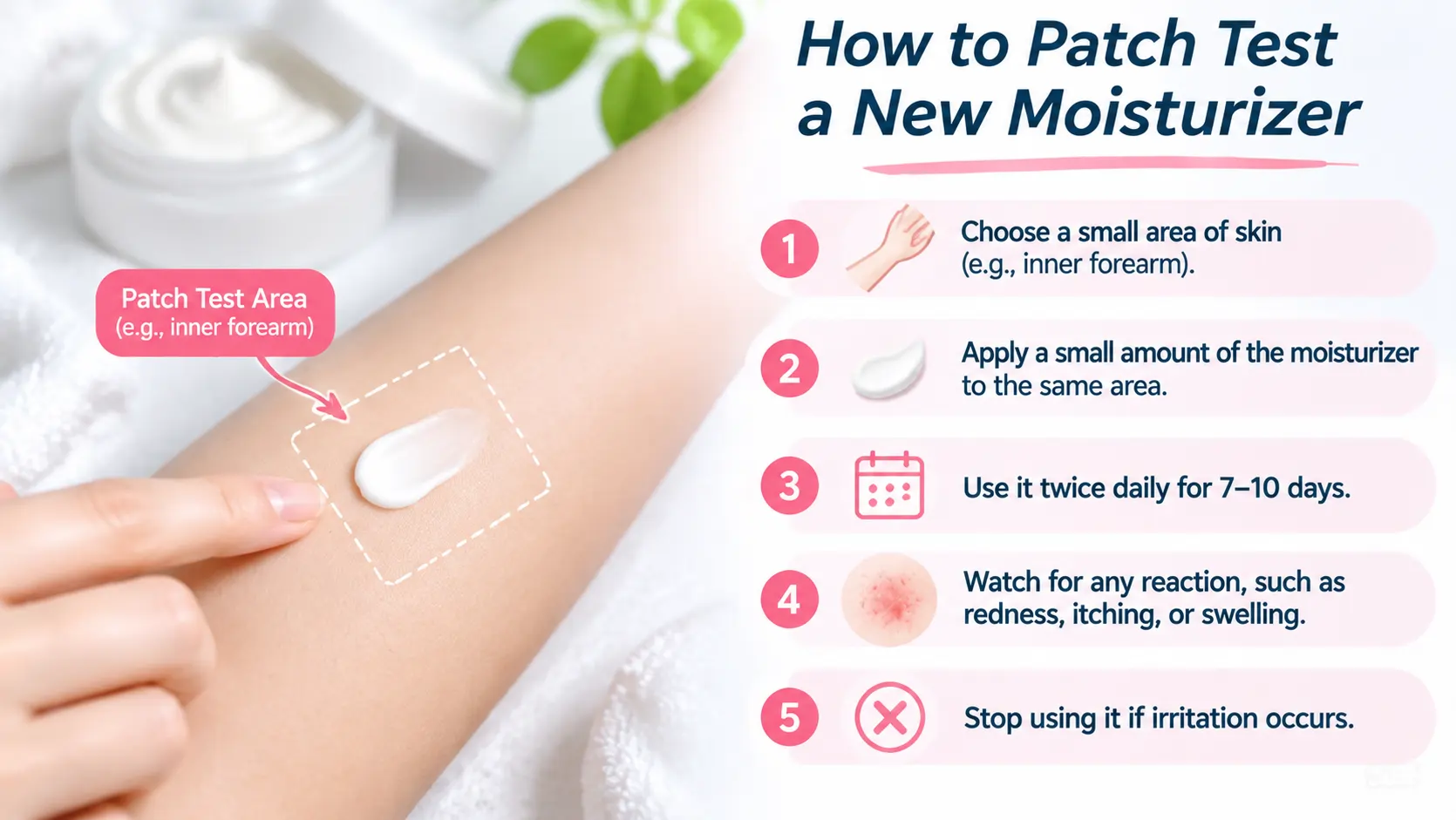
Before applying a new moisturizer to your entire face, consider testing it on a small area of skin.
A practical home-testing approach recommended by dermatology guidance is:
- Choose a small area of skin, such as the inner forearm or inside of the elbow.
- Apply a small amount of the product to the same area.
- Repeat the application twice daily for 7 to 10 days, following the product’s normal usage instructions.
- Observe the area for redness, itching, swelling, burning, or other signs of irritation.
- Stop using the product if an adverse reaction develops.
A home-use test can help identify some potential reactions, but it cannot guarantee that a product will not cause a reaction when applied to the face.
It also cannot replace professional allergy testing. If you have a history of severe allergic reactions, consult a dermatologist before trying unfamiliar skincare ingredients.
Introduce One New Product at a Time
Avoid introducing several new skincare products simultaneously.
If you experience irritation after changing multiple products, identifying the responsible ingredient or formulation can become difficult.
Introducing products individually makes it easier to monitor your skin’s response.
Do Not Test Products on Broken or Severely Irritated Skin
If your skin is actively inflamed, cracked, or damaged, introducing new cosmetic products may cause additional discomfort.
Focus on a simple, previously tolerated skincare routine and seek medical advice if symptoms are significant or persistent.

11. When Should You See a Dermatologist About Sensitive Skin?
Occasional dryness or mild irritation may improve after simplifying your skincare routine and using an appropriate moisturizer.
However, persistent skin sensitivity may sometimes indicate an underlying dermatological condition that requires professional evaluation.
Symptoms That May Require Medical Evaluation
Consider consulting a dermatologist if you experience:
- Persistent redness or inflammation.
- Recurring itching, burning, or stinging.
- Frequent rashes after using skincare products.
- Dry, cracked, or peeling skin that does not improve.
- Recurring facial irritation or unexplained skin reactions.
- Symptoms that interfere with sleep or everyday activities.
Possible Conditions Associated With Sensitive Skin
Sensitive skin is a descriptive term rather than a specific medical diagnosis. Several skin conditions can cause symptoms commonly associated with sensitivity.
- Atopic Dermatitis: A chronic inflammatory skin condition commonly associated with dryness, itching, and recurring eczema.
- Contact Dermatitis: Skin inflammation caused by exposure to irritating or allergenic substances.
- Rosacea: A chronic inflammatory condition that may cause facial redness, flushing, and sensitivity.
- Seborrheic Dermatitis: A condition that can cause redness and scaling, particularly around oily areas of the face.
These conditions can have overlapping symptoms, so professional assessment may be necessary to determine the underlying cause.
When to Seek Urgent Medical Attention
Seek urgent medical attention if a skin reaction is accompanied by rapidly developing facial or throat swelling, difficulty breathing, or other signs of a severe allergic reaction.
Do not rely on moisturizer or other cosmetic products to manage a potentially serious allergic reaction.
12. Frequently Asked Questions About Moisturizers for Sensitive Skin
What is the best moisturizer for sensitive skin?
The best moisturizer for sensitive skin is generally a well-tolerated formulation that provides adequate hydration without triggering irritation. Fragrance-free products containing ingredients such as ceramides, glycerin, or petrolatum may be suitable options depending on your skin type.
Should sensitive skin use a moisturizer every day?
Yes. Daily moisturizing can help maintain hydration and support the skin’s protective barrier. Many people with sensitive skin benefit from applying moisturizer once or twice daily, especially after washing their face or bathing.
Is CeraVe good for sensitive skin?
Some CeraVe moisturizers are formulated with ceramides and other moisturizing ingredients and may be suitable for sensitive skin. However, individual tolerance varies, so check the complete ingredient list and test a new product before regular use.
Is Cetaphil good for sensitive skin?
Some Cetaphil products are designed for dry or sensitive skin and contain moisturizing ingredients that help maintain skin hydration. The suitability of a particular product depends on its formulation and your individual skin sensitivities.
Is hyaluronic acid good for sensitive skin?
Hyaluronic acid is a humectant that attracts and retains water in the outer layers of the skin. It is generally well tolerated and can be included in moisturizers for sensitive skin. However, the overall formulation matters more than any single ingredient.
Can moisturizer make sensitive skin worse?
Yes. A moisturizer may cause irritation or allergic reactions if it contains ingredients that your skin does not tolerate. Fragrance, certain preservatives, and individual allergens may be responsible. Stop using a product that consistently causes irritation.
Is a gel moisturizer or cream better for sensitive skin?
Neither is universally better. Gel moisturizers are generally lighter and may suit oily sensitive skin, while creams are often more suitable for dry sensitive skin. Choose based on your skin’s hydration needs and tolerance.
Can I use the same moisturizer on my face and body?
Some moisturizers are suitable for both facial and body use, but not all products are formulated for both areas. Check the product instructions and consider your facial skin type, particularly if you are prone to acne or irritation.
How long does it take for a moisturizer to improve dry sensitive skin?
Some people notice improved skin comfort and hydration shortly after applying moisturizer. However, supporting recovery of a compromised skin barrier may take longer and depends on the underlying cause, severity, and consistency of skincare. Persistent symptoms should be evaluated by a dermatologist.
Should I stop using moisturizer if my face stings?
If a moisturizer causes persistent burning or stinging, stop using it and assess whether another ingredient or underlying skin condition may be responsible. Significant, recurring, or worsening symptoms should be discussed with a dermatologist.
Can sensitive skin use anti-aging moisturizers?
Yes, but product selection requires care. Some anti-aging formulations contain retinoids, exfoliating acids, or fragrances that may irritate sensitive skin. Consider a simpler fragrance-free formulation and introduce active ingredients gradually under appropriate guidance.
13. Final Thoughts: Finding the Right Moisturizer for Sensitive Skin
Choosing the best moisturizer for sensitive skin is ultimately about finding a formulation that maintains hydration, supports the skin barrier, and feels comfortable with regular use.
Rather than relying on expensive products or complicated skincare routines, start with a few practical principles:
- Choose fragrance-free formulations whenever possible.
- Look for well-tolerated moisturizing ingredients such as ceramides and glycerin.
- Select a cream, lotion, or gel according to your skin type.
- Apply moisturizer consistently, especially after cleansing.
- Introduce new products gradually and monitor your skin’s response.
- Seek professional advice if irritation persists or becomes severe.
Remember that sensitive skin is not identical for everyone. A moisturizer that works well for one person may not be suitable for another. Understanding your skin’s needs and choosing products carefully is more useful than following skincare trends.
With a simple, consistent routine and suitable products, you can help maintain skin hydration and support a healthier-looking skin barrier.